Updates

  1. Person pages list letters, writing, profiles and links as sortable tables with filters, and show each person's companies as links; Fund letters show each letter's description in its own column.
  2. Experts show a checked job title and a short description of each person; 30 more people have photographs.
  3. Every company, fund, university and publication the experts work for has a page listing the people there.
  4. Fund letters show each letter's thesis and filter by it; 225 person pages list the essays, columns and newsletter issues the person wrote.
  5. Person pages list every essay and newsletter issue a person wrote, and their own books as a table in List view.
  6. Recommends shows the five largest kinds of book and the rest under More; browse pictures load sooner.
  7. Podcasts and talks link the original episode, filter by Audio and video or Press, and list each publisher once.
  8. Pages are wider, Recommends has List and Grid, and a filter clicked again turns off.
  9. Book cards sit in a ruled grid with Open Library and Goodreads links and each book's one-line note.
  10. Funds is now Investors; each investor's styles are buttons that filter the table.
  11. Podcasts and talks on a person's page filter by year and publisher and show as a list or a grid of pictures.
  12. Quotes show only people's own words: 472 summaries written by list sites are gone.
  13. Country pages open from Browse again, and every link on the shelf lands on a page.
  14. Subject and person pages show their sections as tabs, and each book appears once on a person's page.
  15. Book cards show the quote, who said it and the source; grids show five cards to a row.
  16. On a phone, a menu holds the sections, search, Updates, Feedback and dark mode.
  17. Feedback takes a screenshot of the page with no browser prompt, opens a screenshot full size when you click it, and clears itself once sent.
  18. Book cards are centred, search names the topic each book sits in, and any text cut short shows whole on hover.
  19. Search groups its results by kind: people, companies, geographies, subjects, topics, books, funds, fund letters and papers.
  20. The Books table lists who recommended each book by name, and the browser tab names the section you are in.
  21. Feedback can take a screenshot of the page, or one you paste or choose, and opens in the corner beside Updates.
  22. Each rail button reopens its section where you left it, and Browse, Table and People show on every book and subject page.
  23. Filters grey out choices that hold nothing instead of hiding them, and Books › People filters by authors or recommenders.
  24. Feedback takes a subject line and up to three screenshots.
  25. Biographies are grouped by the person they are about: 41 new pages, from Abraham Lincoln to Lee Kuan Yew.
  26. Sport splits into 23 sports, and Religion into one topic per faith.
  27. Book lists show as cards: the cover, one recommendation quote and every recommender by name.
  28. Seventeen subjects that had two or three pages under different names now have one page each.
  29. Every page lists its Experts as authors and recommenders, with a link to them on the Experts tab.
  30. Economics, Financial history, Financial panics and Accounting are subjects of their own, with one page per financial crisis.
  31. Book, person and subject pages open inside the app, so the tabs stay in view.
  32. 996 more book covers, and photographs or logos for 227 more people and companies.
  33. Books › Browse shows every subject as cards, and the rail holds Fund letters, Papers, Experts, Books and Funds.
  34. Every topic over 150 books splits into narrower topics, each with a page of its own.

Send feedback

What is it?
Screenshots, up to 3 (optional)
or paste one with Ctrl+V

We use your email only to reply to you.

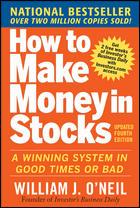
How to Make Money in Stocks

How to Make Money in Stocks

William J. O'Neil
1988
T2 269 pages · about 4h 29m to read Open Librarygoodreads

Sets out the CAN SLIM system; several revised editions.

Summary

William O'Neil founded Investor's Business Daily and built a database of the biggest-winning American stocks going back to the 1950s. This book sets out what he claims that database shows about the characteristics those stocks shared immediately before their largest advances. He organises the findings into the acronym CAN SLIM: current quarterly earnings up sharply, annual earnings growth over several years, new products or new management or new price highs, supply and demand visible in share count and volume, leader rather than laggard within an industry group, institutional sponsorship increasing, and market direction confirming.

The method is momentum investing built on fundamental screens. O'Neil argues against buying stocks near their lows and against averaging down, and he insists on selling any position that falls seven to eight per cent below the purchase price. He devotes substantial space to chart patterns, particularly the cup-with-handle base, and to reading volume as evidence of institutional accumulation. Later editions add material on the 2000 and 2008 declines and on distribution days as a market-timing signal.

Academic work on momentum and on earnings-announcement drift supports the general direction of O'Neil's observations, but his specific rules have never been independently validated on out-of-sample data, and his backtests were conducted by his own firm. The approach generates high turnover and produces its worst results in range-bound markets, where the stop-loss rule triggers repeatedly. The chart-pattern material is the weakest part and rests on visual classification that different readers apply differently.

Key takeaways 7

  1. The biggest-winning stocks showed sharply accelerating quarterly earnings before their major advances, not after them.
  2. Investors should buy stocks near their highs rather than near their lows, because new highs indicate the absence of overhead supply.
  3. Any position that falls eight per cent below the purchase price should be sold without exception or reconsideration.
  4. Industry group leadership matters, and the second-best company in a strong group usually underperforms the best one badly.
  5. Rising institutional ownership signals accumulation, while very high institutional ownership signals that the buying is finished.
  6. Three quarters of stocks follow the general market direction, so an investor should reduce exposure when the major indices show distribution.
  7. Companies buying back stock and carrying small share counts produce larger price moves on the same earnings improvement.

Who should read it

Individual investors who want a rule-based growth and momentum system with explicit sell discipline, and who accept high turnover.

About William J. O'Neil

Founder, Investor's Business Daily and William O'Neil + Co.; creator of the CAN SLIM method

How to Make Money in Stocks codified growth-momentum stock selection and remains the standard reference for it.

Investor's Business Daily, William O'Neil + Co.

Similar books 6

Chosen by shared topics, the entries that hold them, and the people who recommended both.
Gary Antonacci · 2014

Absolute momentum as a systematic substitute for judgement.
Nicolas Darvas · 1960

Introduces the box theory and trailing stop discipline.
Stan Weinstein · 1988

Stage analysis: using charts to time stocks through bull and bear markets.

Where it sits in the reference 2

Investors
Investment styles

Topics

Investing