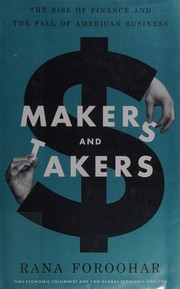
Makers and Takers
How finance's habits spread through the economy, and why the crash taught little.
Summary
Rana Foroohar, then an economic columnist at Time and later at the Financial Times, argues that the financial practices behind the 2008 crash have spread from banks into all of American business. She calls the trend the "financialization of America": finance and its way of thinking come to rule companies that once made things, so firms favour balance-sheet engineering over investment and short-term profit over hiring. She builds the case on reporting and interviews on Wall Street and in Washington.
The publisher's copy lists her numbers. About 15 per cent of the money in the market system reaches the real economy; the rest circulates inside finance. The financial sector takes a quarter of corporate profits while creating 4 per cent of American jobs. The tax code favours debt over equity, which makes it easier for companies to hold cash overseas, and the largest corporations spend more on share buybacks than on research. Most of the regulation promised after 2008 had not arrived. Foroohar tells stories of "Takers" and "Makers" and proposes ways to change the system; a later edition adds material on how the financial system fed the rise of Donald Trump.
Key takeaways 5
- Foroohar argues that finance's methods have spread from banks into the management of ordinary American companies.
- She reports that only about 15 per cent of money in the market system reaches the real economy.
- The financial sector takes a quarter of corporate profits but creates 4 per cent of jobs.
- Large corporations spend more on share buybacks than on research and innovation.
- Tax rules that favour debt over equity push companies toward financial engineering.
Who should read it
Readers who want a journalist's case that Wall Street's growth has come at the expense of productive business.
Who recommended it 1
Similar books 6
Chosen by shared topics, the entries that hold them, and the people who recommended both.

Life on Salomon Brothers' bond trading floor in the 1980s mortgage-bond boom.
“And then "Liar's Poker" from Michael Lewis, love that. I really like - I mythologize like Lewis Ranieri and all these guys when I read it.” — Chamath Palihapitiya
Source: Transcript: Chamath Palihapitiya
Recommended by: Chamath Palihapitiya, Michael Burry and 5 others

How Banco Santander grew from a Spanish regional bank into a global one.
A commissioned history of the Northern Rock Building Society, before its run.
How Wall Street abandoned its economic function, and why that led to the crisis.

A telecom analyst on the conflicts of interest in research during the 1990s bubble.
A defence of finance, arguing that crises call for more financial innovation.
Where it sits in the reference 1
Topics 2
As an Amazon Associate I earn from qualifying purchases.