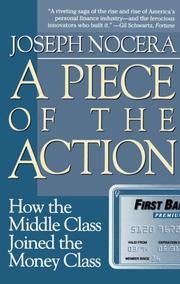
A Piece of the Action: How the Middle Class Joined the Money Class
How the charge card and consumer credit business Amex pioneered was built.
Summary
Nocera writes the history of how ordinary Americans gained access to financial products previously available only to the wealthy, covering roughly 1958 to 1994. His argument is that a series of specific innovations, most of them resisted by incumbents, changed the relationship between the middle class and financial markets permanently.
The innovations he covers include the mass mailing of BankAmericard in Fresno in 1958, which created the general purpose credit card and which the bank conducted with almost no underwriting; the money market fund, created by Bruce Bent and Henry Brown, which gave small savers access to money market rates that regulation prevented banks from paying and which drained deposits from the banking system; the growth of the mutual fund industry and the arrival of Fidelity's Magellan under Peter Lynch as a mass retail product; the discount brokerage created by Charles Schwab after commission deregulation in 1975; and the shift from defined benefit pensions to individual retirement accounts and 401k plans, which transferred investment decisions and investment risk to individuals.
Nocera treats these as democratisation and also documents the costs, including consumer debt, the savings and loan crisis and the exposure of unprepared individuals to market risk.
The book ends in 1994 and therefore predates online brokerage, index fund dominance, the 2008 crisis and the current retirement position. Nocera is a journalist and the treatment is narrative rather than analytical. The account of how each product was created and resisted is the substantive material, and the money market fund and 401k chapters explain structural features of American finance that persist.
Key takeaways 8
- The general purpose credit card was created by mass mailing unsolicited cards in Fresno in 1958 with almost no underwriting.
- Money market funds gave small savers access to market interest rates that regulation prevented banks from paying, which drained deposits from the banking system.
- Financial innovations that served ordinary savers were resisted by incumbents whose business depended on the previous arrangement.
- Commission deregulation in 1975 made discount brokerage possible, which changed who could afford to trade securities.
- The shift from defined benefit pensions to individual accounts transferred both the investment decisions and the investment risk to individuals.
- Mutual funds became mass retail products through marketing and through the performance record of a small number of visible managers.
- Access to financial products increased both participation in markets and household debt, and the two arrived together.
- The book ends in 1994 and predates online brokerage, index fund dominance and the current retirement position.
Who should read it
Investors and financial operators who want the history of how retail financial products were created and why the structures took their current form.
Where it sits in the reference 2
Who recommended it 3 · 2 direct
Similar books 6
Chosen by shared topics, the entries that hold them, and the people who recommended both.




