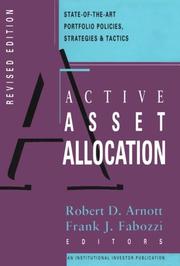
Active Asset Allocation: State-of-the-Art Portfolio Policies, Strategies & Tactics
Edited volume, Probus. Open Library API unreachable this pass.
Summary
The reference has not verified this book in detail; the summary states only what the title, author and subject establish.
Fabozzi edited this collection of contributions on asset allocation, covering the analytical methods and the strategies practitioners were using at the time. The reference has not verified the individual chapters.
The subject covers the decision about how to divide a portfolio among asset classes, which the literature consistently finds explains most of the variation in portfolio returns over time. The analytical territory includes mean-variance optimisation and its practical problems, particularly the sensitivity of the resulting weights to small changes in estimated expected returns; the estimation of the inputs, which is where the difficulty actually sits; approaches that reduce estimation error including shrinkage estimators, resampling and the Black-Litterman method that combines market equilibrium weights with investor views; and the distinction between strategic allocation set for the long term and tactical deviation from it.
Active allocation specifically means varying the weights in response to changing expectations about asset class returns, which requires both a forecasting method and a discipline for acting on it. The contributions would cover valuation-based approaches, momentum and trend approaches, and the risk management of an allocation that changes.
The related territory includes dynamic strategies such as constant proportion portfolio insurance, rebalancing policies and their return contribution, and the implementation of allocation decisions through derivatives rather than through cash markets.
Readers should consult the table of contents to identify the chapters relevant to their purpose, and should note that the practical toolkit has changed substantially with the availability of low-cost index instruments and with the development of risk parity and factor-based allocation approaches.
Key takeaways 7
- Asset allocation explains most of the variation in a portfolio's returns over time, which is why the decision dominates security selection.
- Mean-variance optimisation produces weights extremely sensitive to small changes in estimated expected returns, which makes raw application unusable.
- The difficulty in allocation is estimating the inputs rather than performing the optimisation.
- Methods including shrinkage, resampling and combining market equilibrium with investor views exist to reduce the effect of estimation error.
- Strategic allocation set for the long term and tactical deviation from it are distinct decisions requiring different justification.
- Rebalancing policy itself contributes to returns and should be set deliberately rather than left to convention.
- Allocation changes can be implemented through derivatives at lower cost and faster than through cash market transactions.
Who should read it
Practitioners working on portfolio allocation who need a reference on the methods, verified against the current toolkit.
About Robert D. Arnott
Founder and Chairman, Research Affiliates (rebranded Syzygy Asset Management, 2026); former CEO of First Quadrant; former editor of the Financial Analysts Journal
Fundamental Indexation launched the smart-beta industry and The Fundamental Index turned it into a book that outlived its news cycle, on top of a long asset-management record.
Where it sits in the reference 2
Similar books 6
Chosen by shared topics, the entries that hold them, and the people who recommended both.