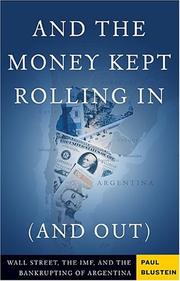
And the Money Kept Rolling In (and Out)
The 2001 default, the IMF's role and the convertibility trap.
Summary
Blustein, a Washington Post correspondent who had earlier written on the Asian crisis, reconstructed Argentina's road to the 2001 default and devaluation, working from interviews with officials at the International Monetary Fund, in the Argentine government and at the banks that sold the debt.
The narrative covers the convertibility regime established in 1991, under which the peso was fixed one to one against the dollar and the currency board arrangement backed the money supply with reserves. This ended hyperinflation and was genuinely popular. Blustein shows how the same arrangement then trapped the country: with no exchange rate adjustment available, and with dollar-denominated debt, the only route to competitiveness was domestic deflation, which the political system could not deliver. Provincial spending, federal transfers and pension privatisation costs widened the deficit, and the debt was refinanced repeatedly in international markets that continued lending.
His analysis of the lending is the most useful part for investors. Argentine bonds were sold aggressively by international banks earning underwriting fees, held by mutual funds and by Italian and Japanese retail investors, and included in emerging market indices that forced index-tracking managers to hold them regardless of credit judgement. The market continued financing the deficit until it abruptly stopped.
On the Fund, Blustein argues it lent repeatedly against programmes it did not believe would work, that the 2001 augmented package was extended for political reasons when the debt was already unsustainable, and that the delay increased the eventual loss.
The book is journalism and does not model the counterfactual. Argentina's post-default recovery was faster than most participants expected, which complicates the assumption that default is the worst outcome, and Blustein's account was written before that was clear.
Key takeaways 7
- A currency board removes exchange rate adjustment, so competitiveness can only be restored through domestic deflation that political systems rarely deliver.
- Dollar-denominated debt in a country earning peso revenue makes devaluation and default nearly the same event.
- International banks earned underwriting fees for selling Argentine debt while their own analysts questioned its sustainability.
- Emerging market bond index membership forced index-tracking managers to hold Argentine debt regardless of credit judgement.
- The International Monetary Fund extended lending against programmes its own staff did not expect to work.
- Delaying an inevitable restructuring increased the eventual loss for creditors and the eventual damage to the country.
- Markets financed an unsustainable deficit continuously until they stopped abruptly, with no gradual repricing in between.
Who should read it
Investors in sovereign debt and anyone working with fixed exchange rate regimes who wants the anatomy of how a widely-held credit failed.
Where it sits in the reference 2
Similar books 6
Chosen by shared topics, the entries that hold them, and the people who recommended both.