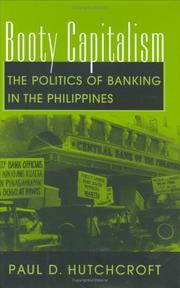
Booty Capitalism: The Politics of Banking in the Philippines
Why oligarch families captured the banks rather than the state capturing business.
Summary
Hutchcroft, a political scientist, analysed the Philippine banking system to explain why the country underperformed its Southeast Asian neighbours despite comparable starting conditions.
His analytical contribution is a typology. Weber distinguished patrimonial states, where officials treat public office as personal property, from rational-legal bureaucracies. Hutchcroft extends this by distinguishing two forms of patrimonialism. In what he calls a patrimonial administrative state, exemplified by Korea and Indonesia under Suharto, a strong state apparatus extracts from a weak business class and can direct resources toward productive investment. In what he calls booty capitalism, exemplified by the Philippines, a powerful oligarchy extracts from a weak state, which means the direction of plunder runs the other way and the state cannot impose performance requirements on anyone.
The banking evidence supports this. Hutchcroft documents family-owned banks lending to their own affiliated companies, the political allocation of bank charters and of central bank support, repeated bank failures rescued at public expense, and the use of government financial institutions as sources of loans to politically connected borrowers that were never repaid. He traces this from the American colonial period through the Marcos years and after, arguing that the pattern survived every regime change because the underlying distribution of power did not change.
His general point is that the developmental state literature's focus on state capacity is correct but that capacity alone is not the variable. What matters is the relative power of state and oligarchy, and the Philippines shows what happens when a state is interventionist enough to create rents but too weak to impose conditions on those who capture them.
The book is academic political economy from 1998. Philippine banking has been reformed substantially since, though the underlying family conglomerate structure persists.
Key takeaways 7
- The direction of extraction between state and oligarchy, not state capacity alone, determines whether intervention produces development.
- In the Philippines a powerful oligarchy extracted from a weak state, which is the reverse of the Korean and Indonesian pattern.
- A state interventionist enough to create rents but too weak to impose conditions produces the worst available outcome.
- Family-owned banks lending to their own affiliated companies removed the credit assessment that lending should provide.
- Bank charters and central bank support were allocated politically, which made banking a route to rent rather than to intermediation.
- Government financial institutions were used as sources of loans to connected borrowers that were never repaid.
- The pattern survived every regime change because the underlying distribution of power between state and oligarchy did not change.
Who should read it
Analysts of emerging market institutions who need a framework for distinguishing states that can direct development from those that merely create extractable rents.
Where it sits in the reference 2
Similar books 6
Chosen by shared topics, the entries that hold them, and the people who recommended both.