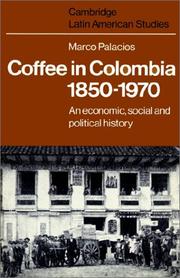
Coffee in Colombia, 1850-1970
Economic history of the crop, the growers' federation and the export institutions built around it.
Summary
The reference has not verified this book in detail; the summary states only what the title, author and subject establish.
Palacios, a Colombian historian, wrote an economic and social history of coffee in Colombia from the mid-nineteenth century to 1970. The reference has not verified the book's detailed contents.
The subject matters because Colombian coffee developed differently from other Latin American export economies. In much of the region, export agriculture concentrated land in large estates worked by dependent labour. In Colombia, coffee production came substantially from smallholders, particularly in Antioquia and Caldas, working plots they owned. The reasons for this and its consequences are the analytical questions.
The consequences examined in the literature include the effect on income distribution, which was less concentrated than in comparable export economies; the political effect, since a large class of smallholding producers has different interests and different political capacity from a landed oligarchy; the role of the National Federation of Coffee Growers, established in 1927, which represented producers, managed quality and marketing, operated a price stabilisation fund and became one of the most powerful institutions in the country; and the effect of international coffee price volatility on the Colombian economy and on public finances, given the export concentration.
Palacios also examines the relationship between coffee and the periods of political violence, including La Violencia after 1948, and the regional structure of Colombian politics.
The book is academic history and the standard reference on its subject. The international coffee agreements that governed the market when it was written collapsed in 1989, which changed the industry's structure substantially.
Key takeaways 7
- Colombian coffee was produced substantially by smallholders working land they owned, unlike the estate systems elsewhere in Latin America.
- Smallholding production produced a less concentrated income distribution than comparable export economies achieved.
- A large class of smallholding producers has different political interests and different organisational capacity from a landed oligarchy.
- The National Federation of Coffee Growers managed quality, marketing and price stabilisation and became one of the country's most powerful institutions.
- Export concentration in a single commodity transmitted international price volatility directly into public finances.
- Regional differences in how coffee was produced shaped Colombia's regional political structure.
- The international agreements governing coffee prices when the book was written collapsed in 1989.
Who should read it
Readers studying commodity export economies and the institutional consequences of smallholder versus estate production.
Where it sits in the reference 2
Similar books 6
Chosen by shared topics, the entries that hold them, and the people who recommended both.