Convertible Arbitrage
The hedged strategy: delta, credit and gamma trading of converts.
Summary
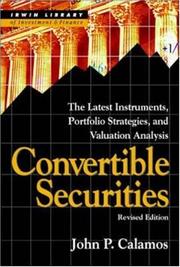
Calamos, of the family investment firm that specialises in convertible securities, wrote a practitioner treatment of convertible arbitrage strategies.
The instrument comes first. A convertible bond is debt that the holder may exchange for a fixed number of the issuer's shares, which makes it a bond plus an equity call option. Its value therefore depends on interest rates, on credit spread, on the share price, on the share's volatility and on the time remaining, and it can be decomposed into those components.
The arbitrage strategy exploits the fact that convertibles have historically been issued cheap relative to the value of their components, because issuers pay for the certainty of placement and because the natural buyer base is narrow. The classic trade buys the convertible and shorts a quantity of the underlying stock determined by the convertible's delta, meaning its sensitivity to the share price. This removes the directional equity exposure and leaves a position that is long volatility, since the hedge must be adjusted as the share price moves, which generates profit when the stock moves in either direction, and that earns the bond's yield less the cost of the short.
Calamos covers the practical management: delta hedging and rebalancing frequency, gamma and what it earns, the credit exposure that remains and how to hedge it with credit default swaps, interest rate exposure, the short borrow cost and recall risk, and the leverage that the strategy conventionally uses.
The risks are structural. The strategy's returns are small per unit of capital and are conventionally amplified with leverage sourced from prime brokers, which means the position depends on continued financing. In 2005 and again in 2008 convertible arbitrage funds suffered severe losses when financing was withdrawn and every participant liquidated the same positions simultaneously. The book predates the second episode.
Key takeaways 7
- A convertible bond decomposes into a bond and an equity call option, and each component can be valued separately.
- Convertibles have historically been issued cheap relative to their components because issuers pay for placement certainty.
- Buying the convertible and shorting stock at the delta removes directional equity exposure and leaves a long volatility position.
- The hedged position profits from share price movement in either direction because the hedge must be rebalanced.
- Credit exposure remains after the equity hedge and must be managed separately.
- The strategy's returns per unit of capital are small, so it is conventionally leveraged, which makes it dependent on prime broker financing.
- Simultaneous liquidation by all participants when financing is withdrawn is the strategy's characteristic failure mode.
Who should read it
Investors and traders working with convertible securities who need the instrument decomposition and the practical hedging framework.
Where it sits in the reference 2
Similar books 6
Chosen by shared topics, the entries that hold them, and the people who recommended both.