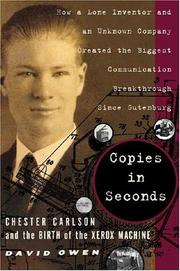
Copies in Seconds
Chester Carlson and xerography, the invention that funded PARC.
Summary
Owen, a New Yorker writer, told the story of Chester Carlson's invention of xerography and of how it became the Xerox 914 copier.
The invention narrative covers Carlson, a patent attorney frustrated by the labour of copying documents, working through the physics in a rented room in Astoria in the 1930s, producing the first electrophotographic image in 1938. The process he devised is genuinely unobvious: charge a photoconductive surface, expose it to light reflected from the original so that the charge dissipates where the image is light, dust it with charged powder that adheres where charge remains, transfer the powder to paper, and fuse it with heat. Owen explains why this was not an incremental improvement on existing chemical copying methods but a different physical principle.
The commercialisation is the business story and the more instructive part. Carlson spent years being rejected by more than twenty companies including IBM, General Electric and RCA, all of which concluded there was no market because carbon paper was cheap and existing demand for copies was small. Battelle Memorial Institute took it on, and Haloid, a small photographic paper company in Rochester, licensed it and eventually staked the entire company on developing it, spending more on the programme than it earned across the years of development.
The 914's launch used a pricing model that solved the demand problem: Xerox leased the machines with a low monthly charge and a per-copy fee, which meant customers took no risk and Xerox captured the volume, which turned out to be vastly larger than any market study had predicted.
Owen writes clearly about both the physics and the business. The book is journalism rather than analysis and does not examine what happened to Xerox afterward.
Key takeaways 7
- Xerography works on a different physical principle from the chemical copying methods it replaced rather than improving on them.
- More than twenty companies rejected the invention because market studies showed existing demand for copies was small.
- Market research measured demand for the existing product and could not detect demand for a capability that did not yet exist.
- Haloid staked the entire company on the programme, spending more on development than it earned in those years.
- Leasing the machine with a low monthly charge and a per-copy fee removed the customer's risk and captured the volume.
- Actual copy volume after launch exceeded every prior estimate by orders of magnitude.
- An inventor without capital or institutional backing required a decade of rejection before finding any organisation willing to develop the work.
Who should read it
Founders and investors evaluating genuinely novel technologies who want a documented case of why market research failed to detect the demand.
Where it sits in the reference 2
Similar books 6
Chosen by shared topics, the entries that hold them, and the people who recommended both.