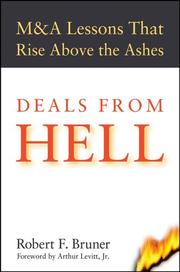
Deals from Hell
Why mergers fail; the break risk an arbitrageur underwrites.
Summary
Bruner studies mergers and acquisitions that destroyed large amounts of value, including AT&T and NCR, Sony and Columbia Pictures, Quaker Oats and Snapple, the Pennsylvania and New York Central railroad merger, Renault and Volvo, Tyco, and the AOL Time Warner combination. Each case gets a reconstruction of the decision process, the price paid, the integration attempt and the eventual write-off.
The analytical claim is that acquisition failure is rarely caused by a single bad judgement. Bruner treats deal failure as a systems problem, in which a complex business environment, tightly coupled execution, cognitive bias in the acquiring executives, and weak governance combine so that a shock which a simpler deal would absorb instead cascades. He explicitly borrows Charles Perrow's normal accident theory, arguing that certain deal structures are accident-prone by design. He also pushes back on the popular claim that most M&A destroys value, arguing the aggregate evidence shows target shareholders gain, acquirer shareholders roughly break even on average, and the losses are concentrated in a recognisable minority of deals.
For acquirers and their boards the practical output is a set of markers that predict trouble: paying with overvalued stock, bidding in a contested auction against a strategic rival, buying outside the core, integrating two organisations of similar size, and closing under time pressure. The academic literature Bruner surveys is now two decades old and the event-study evidence has been refined since, but the case reconstructions remain the strongest part and have not been superseded.
Key takeaways 7
- Most acquisitions do not destroy value on average, but the losses are heavily concentrated in a minority of deals that share identifiable structural features.
- Deal disasters result from the interaction of several individually survivable problems, not from one large mistake.
- Paying with stock that the acquirer's own management believes is overvalued predicts poor long-run returns for acquirer shareholders.
- Mergers of roughly equal-sized firms fail more often than clear acquisitions because no one has unambiguous authority to make integration decisions.
- Competitive auctions push winning bidders past the point where the synergy assumptions can be met.
- Boards that lack independent valuation advice and adequate time systematically approve prices that cannot be justified.
- Executive hubris shows up concretely as revenue synergy estimates that are never tested against a base case.
Who should read it
Board members, corporate development teams and investors assessing whether a proposed acquisition carries the structural markers of the deals that fail.
Where it sits in the reference 6
Similar books 6
Chosen by shared topics, the entries that hold them, and the people who recommended both.