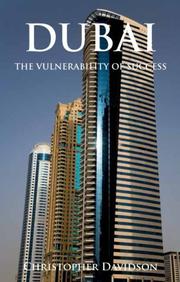
Dubai: The Vulnerability of Success
The emirate's development model and its structural dependencies.
Summary
Davidson, an academic specialising in the Gulf, wrote an analysis of Dubai's development model and of the risks in it, published in 2008 as the emirate's construction boom was peaking.
The historical account traces Dubai from a pearling and trading port through the establishment of the Al Maktoum rule, the early recognition that its oil reserves were small relative to Abu Dhabi's and would not last, and the resulting strategy of building an economy on trade, logistics, tourism, real estate and financial services instead.
The model's components are covered specifically: the free zones with separate legal and regulatory arrangements permitting foreign ownership, the port and airport infrastructure and the airline built around it, the real estate developments financed and sold off-plan, the financial centre operating under a separate common law jurisdiction, and the marketing that made the emirate internationally visible.
The vulnerabilities of the title are the analytical content. Davidson identifies the dependence on continuous capital inflow to fund construction whose end demand was uncertain; the debt taken on by state-linked developers that carried no formal sovereign guarantee; the dependence on foreign workers who constitute the overwhelming majority of the population without citizenship or rights; the political question of a small ruling group's legitimacy; the regional security exposure, particularly to Iran; and the relationship with Abu Dhabi, whose oil wealth was the ultimate backstop.
The timing was accurate. In November 2009 Dubai World announced a debt standstill, property prices collapsed, and Abu Dhabi provided support on terms that shifted the balance between the emirates. Davidson's identification of the debt and the guarantee ambiguity as the central vulnerability was correct. The book predates the recovery that followed and the current position.
Key takeaways 7
- Dubai built its economy on trade, logistics, tourism and real estate because its oil reserves were small and short-lived.
- Free zones with separate legal arrangements permitting foreign ownership were the instrument for attracting international business.
- Real estate development was financed by off-plan sales, which made the model dependent on continuous new buyer inflow.
- State-linked developers carried debt with no formal sovereign guarantee, and the ambiguity was itself the risk.
- Foreign workers constitute the overwhelming majority of the population without citizenship or political rights.
- Abu Dhabi's oil wealth was the ultimate backstop, which meant Dubai's independence depended on not needing it.
- The 2009 Dubai World standstill confirmed that the debt and guarantee ambiguity identified here was the binding vulnerability.
Who should read it
Investors and operators in the Gulf who want the analysis of a non-oil development model and the specific vulnerabilities that materialised.
Where it sits in the reference 2
Similar books 6
Chosen by shared topics, the entries that hold them, and the people who recommended both.




