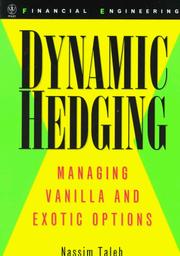
Dynamic Hedging
Technical manual on managing vanilla and exotic options
Summary
Taleb wrote this while working as an options trader, and it is a practitioner's manual for managing a book of vanilla and exotic options rather than a textbook on pricing. He states the premise directly: pricing models are widely available and largely commoditised, while the difficult part is managing the resulting risk in markets that do not behave as the models assume.
The technical content covers the option Greeks in far more depth than standard texts, including the higher-order and cross derivatives that matter to a real book, and the ways each behaves badly near expiry or near a barrier. He treats gamma and its behaviour as a position ages, vega across the volatility surface rather than as a single number, the difference between the volatility used for pricing and the volatility actually realised, and the way delta hedging performs when moves are discontinuous. Large sections cover exotic instruments, particularly barrier options, whose hedge ratios become unstable near the barrier and can require positions larger than the market can absorb.
The argument that carries into Taleb's later work is present throughout. Markets gap rather than moving continuously, so hedges constructed on continuous-time assumptions fail exactly when needed. Liquidity disappears when everyone needs it. Volatility is not constant across strikes or over time. Correlation moves toward one in a crisis. Risk measured from historical distributions understates the tails.
The book is difficult, disorganised and assumes a working options trader's knowledge. It is dated in market specifics, since the instruments, electronic markets and margin regimes have changed since 1997. It remains the standard reference for the practical behaviour of option risk as distinct from option pricing, and its treatment of barrier option hedging is not covered as thoroughly anywhere else.
Key takeaways 7
- Option pricing models are commoditised while managing the resulting risk is not, so the difficulty is in the hedging rather than the pricing.
- Delta hedging assumes continuous price movement, and markets gap, so the hedge fails precisely in the conditions it exists to protect against.
- Barrier options produce hedge ratios that become unstable near the barrier and can demand positions the market cannot absorb.
- Volatility varies across strikes and maturities, so a single vega number misrepresents the risk in an options book.
- Implied volatility used for pricing and realised volatility experienced by the hedger are different quantities and their difference is the trader's profit or loss.
- Liquidity is a function of market conditions, so risk measures assuming a constant ability to transact are wrong when it matters.
- Correlations between assets rise toward one during crises, which removes the diversification a hedged book was relying on.
Who should read it
Options traders and derivatives risk managers who need the practical behaviour of option risk rather than pricing theory.
About Nassim Nicholas Taleb
Former options trader; Distinguished Professor of Risk Engineering, NYU Tandon; scientific adviser to Universa Investments
The Incerto is the primary source for how markets and institutions handle tail risk, and the accompanying technical work supplies the mathematics others cite.
Where it sits in the reference 3
Similar books 6
Chosen by shared topics, the entries that hold them, and the people who recommended both.