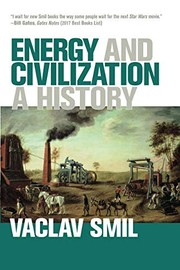
Energy and Civilization
Why energy transitions historically take decades, not years.
Summary
Smil traces human history through energy conversions, from muscle power through fire, domesticated animals, water and wind, coal, oil, gas and electricity, and argues that the quantity and quality of energy available determines what a society can do and how it is organised.
His method is quantitative throughout. He calculates power outputs in watts for human labour, animal traction, waterwheels, windmills, steam engines and turbines, and traces the increases across periods. This lets him make claims that qualitative history cannot, including the specific limits on pre-industrial agriculture, the number of people a given energy source could support, and the reasons certain technologies could not have been adopted earlier.
His central argument is that energy transitions are slow, taking fifty to a hundred years for a new source to reach a substantial share of supply, because the infrastructure, the capital stock and the end-use devices all have to be replaced. He treats this as a physical and economic constraint rather than as a policy failure. He is consistently sceptical about claims that transitions can be accelerated dramatically, and about forecasts that extrapolate early adoption rates.
Smil writes densely and the book is closer to a reference work than to a narrative. He does not construct arguments so much as accumulate quantities, which readers find either bracing or exhausting. His scepticism about transition speed has been challenged by the pace of solar and battery deployment since publication, though the total system replacement he is describing remains slow. Gates cites him frequently, which is how many business readers encountered him.
Key takeaways 8
- The quantity and quality of energy available to a society determines what it can produce and how it is organised.
- Pre-industrial agriculture faced a hard limit set by the energy available from human and animal muscle, which capped population and urbanisation.
- Energy transitions have historically taken fifty to a hundred years for a new source to reach a substantial share of supply.
- Transition speed is constrained by infrastructure, capital stock and end-use devices, all of which must be replaced rather than only the source.
- Energy density determines what applications a source can serve, which is why liquid fuels persist in transport regardless of alternatives.
- Efficiency improvements historically increased total consumption rather than reducing it, since cheaper energy expanded its uses.
- Quantitative analysis of power outputs explains why certain technologies could not have been adopted earlier regardless of knowledge.
- Smil's scepticism about accelerating transitions has been challenged by the pace of solar and battery deployment since publication.
Who should read it
Investors and operators in energy and industry who want quantitative grounding on what energy sources can physically do and how fast systems change.
About Vaclav Smil
Distinguished professor emeritus at the University of Manitoba; writes quantitative histories of energy, food, materials and technical change.
Each book counts the physical inputs an economy consumes - joules, tonnes of steel, ammonia, cement - and establishes the historical rates at which past energy transitions actually moved. Those numbers let an investor size decarbonisation timelines and test claims about how fast an energy system can be rebuilt.
Where it sits in the reference 3
Who recommended it 3 · 3 direct
Similar books 6
Chosen by shared topics, the entries that hold them, and the people who recommended both.