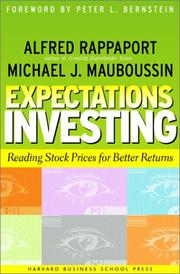
Expectations Investing: Reading Stock Prices for Better Returns
Revised edition published 2021 by Columbia Business School Publishing.
Summary
Rappaport and Mauboussin invert the standard valuation exercise. Instead of forecasting cash flows and comparing the resulting value to the price, they start from the price and ask what a company must deliver to justify it. They call this reading the expectations embedded in the stock, and the method has three steps: estimate the price-implied expectations for sales growth, operating margin and incremental investment; use competitive strategy analysis to judge whether those expectations are too high or too low; and act only when the gap is large.
The machinery is discounted cash flow, but used differently. The authors introduce the market-implied forecast period, the length of time the market is pricing the company to earn returns above its cost of capital, and they connect the valuation inputs to specific operating drivers such as volume, price mix, operating leverage, economies of scale and cost efficiency. They then map industry structure and competitive position onto those drivers, using Porter's framework and Christensen's disruption work, so that the strategic judgement produces a number.
The method is directly useful for public equity investors and for corporate managers thinking about what the market is asking them to deliver. The revised 2021 edition updates the treatment of intangible investment, buybacks and the accounting distortions that make reported earnings a poor input. The main criticism is that price-implied expectations are only as good as the reverse-engineering assumptions, particularly the cost of capital and the forecast period, and small changes in those inputs move the implied growth rate substantially. The approach also works better for established businesses than for companies whose value sits in options on future markets.
Key takeaways 7
- Investors should start from the current share price and derive the operating performance it requires, rather than build a forecast and compare it to price.
- A stock's price implies a specific forecast period during which the company earns returns above its cost of capital, and that period is itself an estimate the investor can test.
- Value creation depends on sales growth, operating margin and incremental investment rate together, so a change in any one of them can be traced to a change in price.
- Competitive strategy analysis is the tool for judging whether price-implied expectations are achievable, which links industry structure directly to valuation.
- Reported earnings and price-earnings multiples are unreliable valuation inputs because accounting treats value-creating investment as expense.
- An investor should act only when the gap between implied expectations and defensible expectations is large, because the estimation error in the method is significant.
- Share buybacks create value for continuing shareholders only when the shares are repurchased below the value implied by defensible expectations.
Who should read it
Public equity investors and corporate managers who want a disciplined method for connecting competitive analysis to what the share price already assumes.
About Michael Mauboussin
Head of Consilient Research, Counterpoint Global, Morgan Stanley Investment Management; previously Chief Investment Strategist at Legg Mason and Chief U.S. Investment Strategist at Credit Suisse
His research reports and Expectations Investing are primary sources that other investors, academics and strategists build directly on.
Where it sits in the reference 4
Who recommended it 1 · 1 direct
Similar books 6
Chosen by shared topics, the entries that hold them, and the people who recommended both.