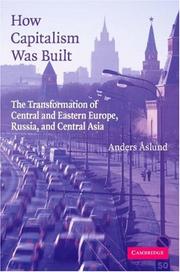
How Capitalism Was Built
Comparative account of the transitions; Poland is the reference case.
Summary
Anders Aslund compares the transformation of twenty-one postcommunist countries in Central and Eastern Europe, the Baltics, the Balkans, Russia and Central Asia from 1989 to the mid-2000s. He advised the Russian and Ukrainian governments during the period and writes as a participant defending the reform programme he helped design. The book's central claim is that speed mattered: countries that liberalised prices, stabilised the budget and privatised early recovered faster and ended with less corruption than those that reformed partially.
Aslund's mechanism is political rather than purely economic. He argues that partial reform creates arbitrage opportunities between controlled and free prices, between subsidised credit and market credit, and between state assets and private buyers. The people who capture those rents then acquire enough wealth to block completion of the reform. On this reading the oligarchs were the product of insufficient liberalisation rather than of too much of it. He uses cross-country data on inflation, output collapse, fiscal balances and corruption indices to support the ranking.
The argument remains disputed. Critics including Joseph Stiglitz and, from a different angle, the authors of Taking Stock of Shock, point to the depth and duration of the output collapse, the mortality crisis in Russia and Ukraine, and the distributional results, and they question whether institutions could be built as fast as prices could be freed. Aslund treats the Baltic states as the model case and Russia's later trajectory undercuts part of his optimism about the durability of the reforms. Read it as the strongest statement of the radical-reform position, best paired with a critic.
Key takeaways 7
- Rapid and comprehensive liberalisation produced better outcomes than gradual reform in the postcommunist transition.
- Partial reform, not full liberalisation, generated the rents that created the oligarchs.
- Early macroeconomic stabilisation determined how quickly output recovered, and delayed stabilisation produced high inflation and larger losses.
- Measured output collapses overstate the real fall because Soviet statistics counted unwanted production and missed new private activity.
- The prospect of European Union membership disciplined reform in Central Europe and had no counterpart further east.
- Corruption in the transition correlates with the persistence of state controls rather than with the pace of privatisation.
- Aslund argues that a strong democratic mandate at the start is the reformer's most perishable asset and must be spent immediately.
Who should read it
Investors and policymakers who want the case for shock therapy stated by one of its architects, with comparative country evidence attached.
About Anders Aslund
Swedish economist who advised Russia and Ukraine on market reform in the 1990s; later a fellow at the Peterson Institute and Atlantic Council.
How Capitalism Was Built compares the post-communist transitions country by country and argues that fast liberalisation with early stabilisation produced better outcomes than gradual reform. Russia's Crony Capitalism follows the money from those reforms into a state organised around asset seizure and offshore ownership, which is the operating environment for anyone holding assets in the region.
Where it sits in the reference 2
Similar books 6
Chosen by shared topics, the entries that hold them, and the people who recommended both.