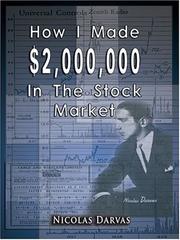
How I Made $2,000,000 in the Stock Market
Introduces the box theory and trailing stop discipline.
Summary
Nicolas Darvas was a professional ballroom dancer who traded American equities by cable from tour stops around the world between 1957 and 1959. He recounts his sequence of methods in order of failure: Canadian penny stocks bought on tips, then fundamental analysis based on earnings and industry reports, then a purely technical approach, and finally the combination he settled on. The book is unusual in giving the losing phases as much space as the winning one.
The method Darvas arrived at, which he called the box theory, works as follows. He watched for stocks whose volume rose sharply, tracked the price range within which each then oscillated, and treated that range as a box. He bought when the price broke above the top of a box on volume, placed a stop-loss just below the breakout point, and raised the stop as the stock established higher boxes. He restricted purchases to companies in industries he expected to produce new products or earnings surprises, which is why he described himself as a techno-fundamentalist. He held very few positions and let the stops remove him from losers.
The account is anecdotal and covers a single strong bull market in a narrow set of names, including Lorillard, Diners Club, E.L. Bruce and Universal Controls. There is no systematic test of the method here, though later momentum research has given qualified support to the underlying observation that stocks making new highs tend to continue. Darvas's specific rules, especially the reliance on stop-loss orders placed close to entry, work poorly in choppy markets and in illiquid securities. Read it for the psychology of position management rather than for a replicable system.
Key takeaways 7
- Price and volume told Darvas more about a stock's near-term direction than any earnings analysis he could perform from a distance.
- An investor should buy strength rather than weakness, entering as a stock breaks above an established trading range on rising volume.
- Every purchase requires a predetermined exit price, set before entry and never widened afterwards.
- Concentration in a handful of positions is defensible when each position carries an automatic stop.
- Being stopped out repeatedly for small losses is the cost of the one position that produces the entire return.
- Distance from the market and from brokers improved Darvas's results by removing the tips and commentary that had previously driven his decisions.
- Darvas restricted his universe to industries with a plausible story about future earnings, and used technical signals only within that universe.
Who should read it
Traders and investors interested in the origins of trend-following and position-sizing discipline, and in a candid record of how a novice's methods failed before one worked.
About Nicolas Darvas
Professional ballroom dancer turned self-taught trader; originator of the Darvas box theory
One enduring book whose box-and-stop method still shapes retail breakout trading, though his record was disputed.
Where it sits in the reference 2
Similar books 6
Chosen by shared topics, the entries that hold them, and the people who recommended both.