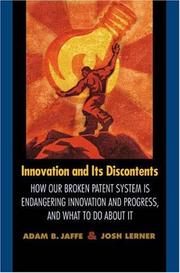
Innovation and Its Discontents
How the patent system drifted from incentive to tax.
Summary
Adam Jaffe and Josh Lerner argue that the American patent system stopped supporting innovation and started obstructing it, and they trace the change to two institutional decisions of the early 1980s. The first was the creation in 1982 of the Court of Appeals for the Federal Circuit, which consolidated patent appeals in a single specialised court that proved markedly more favourable to patent holders. The second was the shift of the Patent and Trademark Office to funding from applicant fees, which gave examiners an institutional interest in granting rather than refusing.
The consequences they document are a sharp rise in patent grants, declining average patent quality, the extension of patentability to software and business methods, and the growth of litigation as a business strategy. They describe firms accumulating patents defensively so they have something to countersue with, and they describe entities that produce nothing and exist to extract settlements. They support this with data on grant rates, litigation volumes and examiner time per application, which they estimate at under twenty hours.
Their proposals are procedural rather than radical: give examiners more time and better information, create a genuine post-grant opposition process so that challenges do not require litigation, and reduce the presumption of validity for patents that received little examination. Several of these were partly adopted in the America Invents Act of 2011, after the book, and the subsequent Supreme Court decisions on software patentability in Alice and on injunctions in eBay changed the environment further. The book's diagnosis of the incentive structure remains accurate; its description of the current legal position does not.
Key takeaways 7
- The creation of a single specialised appeals court in 1982 systematically shifted American patent law toward patent holders.
- Funding the patent office from applicant fees gave the institution a financial interest in granting applications.
- Patent examiners spend under twenty hours on the average application, which cannot support a meaningful validity determination.
- Firms accumulate patents as litigation deterrents rather than as protection for specific inventions.
- Low-quality granted patents impose costs on innovators because challenging them requires litigation rather than administrative review.
- A genuine post-grant opposition procedure would filter bad patents at a fraction of the cost of court invalidation.
- The presumption of validity is indefensible for patents that received only a few hours of examiner attention.
Who should read it
Founders and investors in technology who need to understand why patent thickets and assertion entities exist and what institutional choices produced them.
Where it sits in the reference 2
Similar books 6
Chosen by shared topics, the entries that hold them, and the people who recommended both.