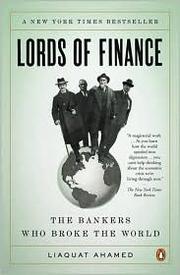
Lords of Finance
The Creditanstalt collapse and its transmission through the 1931 European banking crisis.
Summary
Ahamed tells the history of the interwar period through the four central bankers who dominated it: Montagu Norman at the Bank of England, Benjamin Strong at the Federal Reserve Bank of New York, Hjalmar Schacht at the Reichsbank and Emile Moreau at the Banque de France. The book won the Pulitzer Prize.
The argument is that the Great Depression resulted substantially from policy decisions rather than from any inevitable process, and that the central error was the commitment to the gold standard at prewar parities. Britain returned to gold in 1925 at the prewar rate, which overvalued sterling and required deflation, and the resulting pressure produced policies across countries that transmitted contraction internationally.
Ahamed covers the reparations question and the disputes over German payments, the American loans that recycled capital to Germany, the Federal Reserve's reduction of rates in 1927 partly to relieve pressure on sterling and its contribution to the stock market boom, Strong's death in 1928 which removed the most capable central banker at the worst moment, and the banking failures and the sequence of departures from gold from 1931 onward.
He writes biographically, so the personalities and their relationships carry the narrative, and he is careful about the constraints each faced. Economists dispute parts of the interpretation, particularly the weight given to individual decisions relative to structural conditions, and the treatment of the gold standard follows the Eichengreen line closely. The economics is explained at a general level. It is the most readable account of how monetary arrangements transmitted a contraction internationally.
Key takeaways 8
- The commitment to restoring the gold standard at prewar parities forced deflation on countries whose currencies were overvalued.
- Britain's 1925 return to gold at the prewar rate overvalued sterling and required years of deflation and unemployment to sustain.
- A fixed exchange rate system transmits contraction internationally, since a country losing gold must raise rates regardless of domestic conditions.
- American rate reductions in 1927, made partly to relieve pressure on sterling, contributed to the stock market boom that followed.
- Reparations and war debts created an unsustainable circular flow that depended on continued American lending to Germany.
- Countries that left the gold standard earliest recovered earliest, which is the strongest evidence that the arrangement rather than the shock caused the depth of the depression.
- Benjamin Strong's death in 1928 removed the central banker most capable of coordinating a response immediately before the crisis.
- Central bankers acted within a framework they believed was a natural law rather than a policy choice, which prevented consideration of alternatives.
Who should read it
Investors and readers interested in how monetary arrangements transmit crises internationally, told through the people who made the decisions.
Where it sits in the reference 6
Who recommended it 2 · 2 direct
Similar books 6
Chosen by shared topics, the entries that hold them, and the people who recommended both.