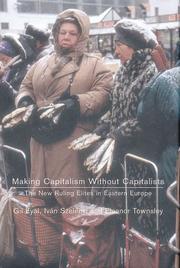
Making Capitalism Without Capitalists
Who ended up owning Central European assets when there were no owners.
Summary
Gil Eyal, Ivan Szelenyi and Eleanor Townsley are sociologists, and they ask who actually took charge of the economies of Central Europe after 1989. Their answer is that the Czech Republic, Hungary and Poland built capitalist economies without a domestic capitalist class, because none existed and none was created quickly enough to matter.
Instead, they argue, power went to a coalition of technocrats, former communist managers, and dissident intellectuals, whose asset was cultural capital rather than property. This group ran the privatisation programmes, staffed the new institutions and set the terms on which foreign capital entered. Ownership of the largest firms passed substantially to foreign corporations, while control of the domestic economy rested with people whose position derived from credentials and networks. The authors call the resulting arrangement capitalism from without and contrast it with Russia, where insiders converted political position into personal property and produced what the authors describe as a form of clientelist or political capitalism.
The book applies Bourdieu's categories of capital to the transition and is written for sociologists, with the theoretical apparatus visible throughout. Its empirical basis is survey data on elite composition across the region. The comparative claim about Central Europe against Russia has held up well. The prediction that a propertied domestic bourgeoisie would remain weak is less clearly correct, given the emergence of large domestically owned groups in Hungary and Poland since, often through political connection in ways the authors would recognise.
Key takeaways 7
- Central Europe built capitalist institutions before it had a capitalist class, so credentials rather than property determined who held power.
- Ownership of large Central European firms passed to foreign corporations while domestic control rested with technocrats and managers.
- The authors distinguish Central Europe's capitalism from without from Russia's conversion of political position into personal property.
- Cultural capital, meaning education, expertise and network position, functioned as the transferable asset when property rights were being redefined.
- Former communist managers and anti-communist dissidents formed a working coalition because both held cultural rather than economic capital.
- The absence of a domestic propertied class made foreign direct investment politically acceptable in Central Europe in a way it was not in Russia.
- Elite composition after a regime change is determined by which resources survive the change, and expertise survives better than office.
Who should read it
Analysts of institutional transition and emerging market ownership structures who want a sociological account of who captured the postcommunist economies.
Where it sits in the reference 2
Similar books 6
Chosen by shared topics, the entries that hold them, and the people who recommended both.