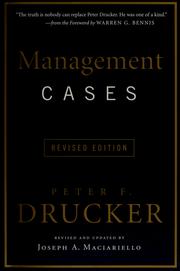
Management Cases
Revised edition prepared with Joseph A. Maciariello
Summary
Peter Drucker assembled these short cases as a companion to his management writing, and Joseph Maciariello revised and expanded the collection for the 2008 edition after Drucker's death. Each case runs a few pages and presents a management situation ending in questions rather than in an answer.
The cases cover the range of Drucker's concerns: defining the purpose of a business, the responsibilities of the chief executive, decisions about people and succession, the management of knowledge workers, innovation and abandonment of obsolete products, non-profit and public sector management, ethics and social responsibility, and the manager's own effectiveness. Many are drawn from real situations Drucker encountered as a consultant, with identifying details changed.
The book is a teaching instrument and does not develop an argument. Its use outside a classroom is limited, since the cases are deliberately underspecified and depend on discussion. For a reader who wants Drucker's positions, the essays and the main treatises state them directly. The cases are most useful to someone running a management development programme who needs short, self-contained situations that do not require financial analysis.
Key takeaways 6
- Drucker treats most management problems as questions about purpose that have been mistaken for questions about technique.
- Deciding what to abandon is a management decision that requires the same rigour as deciding what to start.
- The cases repeatedly show managers solving the problem in front of them while the real problem lies in how the business was defined.
- Personnel decisions carry consequences that are difficult to reverse, which is why Drucker treats them as the executive's highest-stakes work.
- Non-profit organisations face the same management problems as businesses without the discipline that a financial result provides.
- Ethical questions in management usually appear as ordinary operating decisions rather than as identifiable dilemmas.
Who should read it
Instructors and managers running development programmes who need short discussion cases grounded in Drucker's framework.
About Peter F. Drucker
Management writer and consultant; professor at Bennington, NYU and Claremont Graduate University
He invented management as a field of study, and The Practice of Management and The Effective Executive remain the primary sources every later writer builds on.
Where it sits in the reference 2
Similar books 6
Chosen by shared topics, the entries that hold them, and the people who recommended both.





