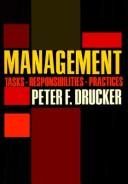
Management: Tasks, Responsibilities, Practices
OL records first publish year as 1974
Summary
Peter Drucker published this in 1973 as a comprehensive treatise on management, running to more than eight hundred pages, and intended it as the field's standard reference. It gathers and systematises the arguments he had developed over the previous twenty years.
The structure follows three tasks Drucker assigns to management: producing the specific performance for which the institution exists, making work productive and the worker effective, and managing the institution's social impacts and social responsibilities. Around these he builds the material on the purpose of a business, which he defines as creating a customer; on objectives and the areas in which every business must set them; on the difference between efficiency and effectiveness; on organisation structure and its alternatives; on top management and boards; on the manager's job and management by objectives; on innovation; and on managing service institutions, which he treats as a distinct problem because they lack the discipline of a market result.
The book is long, discursive and free of data in the modern sense: Drucker argues from observation, consulting experience and historical example rather than from research. That is the standard criticism of him, and it is fair. His specific claims about organisational structure have been superseded, his treatment of labour relations belongs to its period, and the material on management by objectives has been heavily qualified by later work on measurement distortion. The framing questions, particularly what business are we in and what should it be, have outlasted the answers.
Key takeaways 7
- The purpose of a business is to create a customer, which makes marketing and innovation the only two functions that produce results.
- Management must ask what the business is, what it will be, and what it should be, and these are three separate questions.
- Efficiency is doing things right and effectiveness is doing the right things, and only the second determines whether the organisation survives.
- Every business must set objectives in multiple areas simultaneously, because optimising a single measure such as profit destroys the others.
- Profit is a condition of survival and a cost of staying in business rather than the purpose of the enterprise.
- Service institutions perform badly because they are paid from budget allocations rather than from results, which removes the signal that would correct them.
- Organisation structure should follow from the work to be done and the results required, and no structure fits all businesses.
Who should read it
Executives who want the systematic version of Drucker's management framework in one place, accepting its length and its argument-from-observation method.
About Peter F. Drucker
Management writer and consultant; professor at Bennington, NYU and Claremont Graduate University
He invented management as a field of study, and The Practice of Management and The Effective Executive remain the primary sources every later writer builds on.
Where it sits in the reference 2
Similar books 6
Chosen by shared topics, the entries that hold them, and the people who recommended both.





