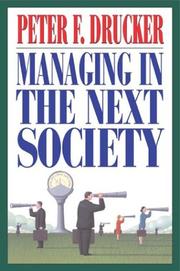
Managing in the Next Society
Summary
Peter Drucker collected these essays and interviews from 2001 and 2002, writing about the aftermath of the internet boom and about the demographic and social changes he expected to define the coming decades.
His argument about the internet is that its significance lies in the elimination of distance rather than in electronic commerce, and that the parallel is with the railway rather than with the telephone. Railways did not principally change the movement of goods; they changed where people could live and what markets a producer could reach, and Drucker expected the same displacement effect from the removal of distance in information. He is dismissive of the valuations of the period and of the assumption that new distribution channels create new businesses.
The social chapters concern what he calls the next society: an ageing population in developed countries, a shrinking working-age cohort, the decline of the manufacturing workforce as a share of employment, the rise of knowledge workers who identify with their field rather than their employer, and the fragmentation of the large corporation into networks of contracts. He also writes about the governance of the corporation given that pension funds are its owners. The pieces are short and were written for The Economist and similar publications, and they repeat each other.
Key takeaways 7
- The internet's significance is the elimination of distance, not the creation of a new sales channel.
- Drucker argues that new distribution technologies displace existing arrangements rather than creating new demand.
- Falling birth rates in developed countries were already determined and would reshape labour markets, pensions and politics with no further uncertainty.
- Knowledge workers identify with their discipline rather than with their employer, which weakens the corporation's claim on their loyalty.
- Manufacturing employment will fall as a share of the workforce regardless of output, as agricultural employment did.
- The large corporation is fragmenting into networks of contractual relationships, which leaves management responsible for activities it does not own.
- Corporate governance is unresolved because the legal owners are pension funds acting for beneficiaries with no interest in governance.
Who should read it
Readers who want Drucker's assessment of the internet's economic significance and of the demographic changes he treated as already settled.
About Peter F. Drucker
Management writer and consultant; professor at Bennington, NYU and Claremont Graduate University
He invented management as a field of study, and The Practice of Management and The Effective Executive remain the primary sources every later writer builds on.
Where it sits in the reference 2
Similar books 6
Chosen by shared topics, the entries that hold them, and the people who recommended both.





