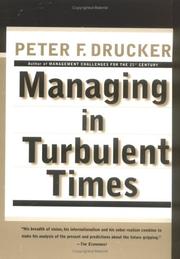
Managing in Turbulent Times
Summary
Peter Drucker wrote this in 1980, at the end of a decade of inflation, oil shocks and slowing productivity growth in the developed economies. His subject is how a business should be managed when the environment cannot be forecast from the recent past.
His central argument is that turbulence makes the fundamentals more important rather than less, and that the appropriate response is to manage for the changes that have already happened rather than to predict the ones that have not. He identifies several as already determined: demographic shifts in the workforce, the emergence of manufacturing capacity outside the developed countries, and the shift toward knowledge work. He argues that businesses should adjust to these rather than plan against forecasts of growth rates.
The financial chapters are the most specific. Drucker attacks conventional accounting for reporting inflationary gains as profit, argues that during inflation businesses must manage liquidity and the productivity of capital rather than reported earnings, and insists that capital costs must be charged fully against operations. He also argues that inflation destroys the information content of accounting numbers and therefore destroys management's ability to allocate. The particular inflationary context has passed, though the accounting arguments applied again during the 2021 and 2022 inflation. The forecasting scepticism and the emphasis on already-determined changes are the durable content.
Key takeaways 7
- Businesses should manage for changes that have already occurred rather than plan against forecasts of changes that have not.
- Inflation makes reported profits fictitious because depreciation and inventory accounting understate the cost of replacing what was consumed.
- During inflation a business must manage liquidity and capital productivity, because reported earnings stop carrying information.
- Turbulence increases the value of a clear definition of the business, since improvisation requires knowing what is being defended.
- Demographic change is the only economic fact that can be forecast reliably, because the people concerned already exist.
- Management must charge the full cost of capital against operations, or it will treat capital as free and allocate it accordingly.
- Drucker argues that a period of turbulence eliminates businesses that grew on cheap capital rather than on productive capacity.
Who should read it
Executives managing through inflation or macroeconomic instability who want an argument about which measures stop working and what replaces them.
About Peter F. Drucker
Management writer and consultant; professor at Bennington, NYU and Claremont Graduate University
He invented management as a field of study, and The Practice of Management and The Effective Executive remain the primary sources every later writer builds on.
Where it sits in the reference 2
Similar books 6
Chosen by shared topics, the entries that hold them, and the people who recommended both.





