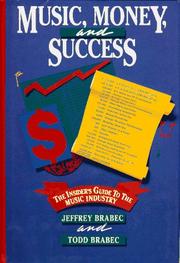
Music, Money, and Success
The publishing-side reference on royalty streams and licensing income.
Summary
Jeffrey and Todd Brabec are music industry attorneys and executives, and this is a reference on how money moves in the music business. It has been revised repeatedly since 1994 and is used as a textbook in music business programmes.
The content is a systematic account of every income source available to a songwriter, composer or artist, and of the contracts that govern each. It covers mechanical royalties for reproduction and the statutory rate that sets them, performance royalties collected by the performing rights organisations and how they are distributed, synchronisation licences for film, television and advertising, print income, recording agreements and the royalty calculations within them, publishing agreements and the difference between the writer's share and the publisher's share, co-publishing and administration deals, foreign collection through subpublishers, and the economics of touring and merchandising.
The book's method is to reproduce contract language and then explain what each clause does financially. Its accuracy about specific rates and about industry practice makes it useful, and that is also why edition matters: the streaming economics, the Music Modernization Act of 2018, and the changes to mechanical licensing administration have all altered the numbers substantially since early editions. Readers should use the most recent edition available and treat older ones as historical.
Key takeaways 7
- A song generates income through several legally distinct rights, and each is licensed, collected and split under different rules.
- The writer's share and the publisher's share of publishing income are separate, and a publishing deal transfers only one of them.
- Mechanical royalty rates for reproduction are set by statute or by rate court rather than negotiated, which caps that income source.
- Performance royalties are collected by societies and distributed by survey and census methods, so the payment reflects sampling rather than actual use.
- Synchronisation licences are freely negotiated and are frequently the largest single payment a song receives.
- Recording agreements recoup advances and specified costs before any artist royalty is paid, which is why a successful record can produce no artist income.
- Ownership of copyright, rather than the size of a royalty percentage, determines who controls and profits from a work over its life.
Who should read it
Musicians, managers and investors in music rights who need a clause-level understanding of how income is generated, split and collected.
Where it sits in the reference 2
Similar books 6
Chosen by shared topics, the entries that hold them, and the people who recommended both.