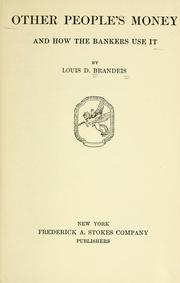
Other People's Money and How the Bankers Use It
The contemporary case against the Morgan money trust.
Summary
Louis Brandeis published these essays in Harper's Weekly in 1913 and 1914, drawing on the Pujo Committee investigation into concentration of financial control. He was appointed to the Supreme Court two years later. The argument is that a small group of New York investment banks had acquired control over American industry that was neither earned nor accountable.
His mechanism is the one the title names: the bankers deployed money that belonged to depositors, policyholders and trust beneficiaries. Through interlocking directorates, they sat simultaneously on the boards of banks, insurance companies, railroads and industrial corporations, and directed the flow of that money toward securities they themselves underwrote. Brandeis works through the arithmetic of underwriting commissions on transactions where the banker sat on both sides, and argues that the fees represented a tax on the economy rather than payment for a service.
The essays contain the sentence about sunlight being the best disinfectant and electric light the most efficient policeman, and the underlying argument for disclosure as a regulatory technique that shaped the securities acts of 1933 and 1934. Brandeis also argues against bigness as such, holding that firms beyond a certain size are inefficient and politically dangerous, a position that ran against the economic consensus then and now. The book is polemical and its specific institutional targets are gone. Its analysis of conflicts arising when a fiduciary controls the deployment of other people's money remains directly applicable to asset management.
Key takeaways 7
- Investment bankers controlled American industry using money belonging to depositors, policyholders and trust beneficiaries rather than their own.
- Interlocking directorates let a small group sit on both sides of transactions and direct capital toward securities they underwrote.
- Underwriting commissions on such transactions were a charge on the economy rather than payment for an independent service.
- Disclosure is a regulatory technique that works by changing behaviour rather than by prohibiting it.
- Brandeis argues that firms above a certain size become inefficient and that their scale reflects financial promotion rather than operating advantage.
- A fiduciary who both advises on and profits from a transaction cannot serve the beneficiary, regardless of intent.
- Concentration of financial control constitutes political power that no electoral process constrains.
Who should read it
Investors and regulators who want the founding argument for disclosure regulation and for scrutiny of conflicts in institutions that deploy other people's capital.
Where it sits in the reference 2
Similar books 6
Chosen by shared topics, the entries that hold them, and the people who recommended both.