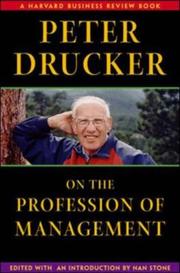
Peter Drucker on the Profession of Management
Summary
This collects Peter Drucker's Harvard Business Review articles, spanning roughly three decades, with an introduction by editor Nan Stone and an interview with Drucker. The pieces are among his most concentrated writing, since the article form forced compression that his books did not.
The collection includes the theory of the business, which argues that every organisation operates on assumptions about its environment, mission and competencies that become obsolete without being noticed; the information executives truly need, which argues that management accounting supplies internal cost data and nothing about the outside world where results occur; managing for business effectiveness; the effective decision; how to make people decisions; the coming of the new organisation, which predicted information-based organisations with fewer management layers; and the new productivity challenge, on knowledge and service work.
As a collection of Drucker at his most disciplined, this is arguably the best single volume of his work. The articles repeat themes from the books but state them more tightly. The prediction pieces have a mixed record: the flattening of organisations and the growth of knowledge work were correct, while some specific institutional forecasts were not. Readers new to Drucker could reasonably start here rather than with the treatises.
Key takeaways 7
- Every organisation operates on a theory of the business whose assumptions are rarely stated and eventually become false.
- A theory of the business is invalidated by the organisation's own success, because success changes the conditions the theory assumed.
- Management accounting reports internal costs and supplies nothing about customers, non-customers or competitors, where results are determined.
- Effective decisions begin by establishing whether the situation is generic or unique, since generic situations require rules rather than decisions.
- People decisions carry the highest consequence and the lowest reversibility, and most executives make them badly and quickly.
- Information technology permits organisations with far fewer management layers, because middle management existed largely to relay information.
- Raising knowledge and service work productivity requires first defining what the task is, which is rarely done explicitly.
Who should read it
Executives who want Drucker's strongest work in its most compressed form, particularly on the theory of the business and on decision-making.
About Peter F. Drucker
Management writer and consultant; professor at Bennington, NYU and Claremont Graduate University
He invented management as a field of study, and The Practice of Management and The Effective Executive remain the primary sources every later writer builds on.
Where it sits in the reference 2
Similar books 6
Chosen by shared topics, the entries that hold them, and the people who recommended both.





