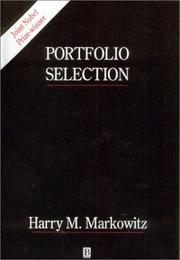
Portfolio Selection
The original mean-variance monograph.
Summary
Harry Markowitz published the paper that founded modern portfolio theory in 1952 and this monograph in 1959, which develops the argument fully and supplies the computational method. It is the source document for how institutional portfolios are constructed.
The central insight is that an asset's contribution to a portfolio depends on its covariance with the other holdings rather than on its own risk and return alone. A security with high variance can reduce portfolio variance if it moves against the rest. From this Markowitz derives the efficient frontier: for each level of expected return there is a portfolio with minimum variance, and no rational investor should hold anything off that frontier. He supplies the critical line algorithm for computing the frontier under constraints, which was the practical contribution given the computing available in 1959.
The monograph also contains material the profession subsequently ignored. Markowitz discusses semi-variance, which measures only downside deviation, and states that it is the more appropriate risk measure but that variance is computationally tractable. He discusses the difficulty of estimating expected returns and covariances, which is the problem that has dominated practical application ever since, since optimisers amplify estimation error and produce concentrated portfolios. Later work on shrinkage estimation, resampling and Black-Litterman all address this. Markowitz himself later said he did not use mean-variance optimisation for his own retirement account. The framework remains the foundation of institutional practice.
Key takeaways 7
- A security's contribution to portfolio risk depends on its covariance with the other holdings rather than on its own variance.
- For each level of expected return there exists a minimum-variance portfolio, and the set of these forms the efficient frontier.
- Diversification reduces risk without reducing expected return, which makes it the only benefit available at no cost.
- Markowitz identified semi-variance as the more appropriate risk measure and used variance because it was computable.
- Mean-variance optimisation amplifies estimation error in expected returns, which produces concentrated and unstable portfolios.
- The critical line algorithm computes the efficient frontier under linear constraints, which made the theory usable in practice.
- Investors should be judged on portfolio outcomes rather than on individual security selection, because the interaction between holdings determines the result.
Who should read it
Investors and researchers who want the founding statement of diversification as a formal problem, including the caveats its author stated and the profession forgot.
Where it sits in the reference 2
Similar books 6
Chosen by shared topics, the entries that hold them, and the people who recommended both.