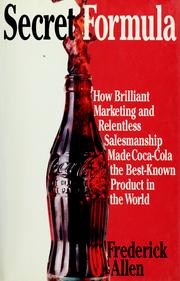
Secret Formula
Woodruff, the bottlers' contract, and the making of the brand.
Summary
Frederick Allen wrote a history of Coca-Cola centred on Asa Candler, who acquired the formula and built the business, and Robert Woodruff, who ran the company for six decades and made it a global brand.
The business decisions are the substance. Candler bought the formula for a small sum from the pharmacist who created it and built distribution through soda fountains. The bottling arrangement, in which Candler granted perpetual bottling rights to two lawyers for one dollar with the syrup price fixed in perpetuity, is the most consequential contract in the company's history: it created an independent bottler network that grew the business enormously and simultaneously locked the company into a syrup price it could not raise for decades, which took generations of litigation and negotiation to resolve.
Woodruff's contributions were the wartime decision to supply Coca-Cola to American servicemen anywhere in the world at five cents, which the government supported with materials and which built bottling infrastructure across Europe and Asia at public expense, and the sustained investment in brand advertising that made the product's meaning independent of its taste.
Allen also covers the New Coke episode as an illustration of what the company had actually built, which was an attachment that had nothing to do with product formulation.
The reference has not verified the specific figures in this account. The book is a business history rather than an analysis, and the perpetual bottling contract is the case investors will find most instructive.
Key takeaways 7
- Coca-Cola granted perpetual bottling rights with the syrup price fixed forever, which built the distribution network and locked in a price the company spent generations trying to escape.
- A contract term that seems trivial when granted can become the company's central strategic constraint once the business scales.
- Supplying servicemen worldwide at a fixed price during the war built bottling infrastructure across Europe and Asia at government expense.
- Sustained brand advertising made the product's meaning independent of its taste, which is what the New Coke episode subsequently demonstrated.
- The independent bottler network grew the business faster than a company-owned system could have and cost the company control over pricing.
- The formula's secrecy functioned as a marketing asset rather than as genuine protection, since the product could be analysed and replicated.
- The reference has not verified the specific figures in this account.
Who should read it
Operators and investors interested in franchise and bottling structures, contract terms that become strategic constraints, and brand independence from product.
About Frederick Lewis Allen
American editor of Harper's Magazine who wrote popular histories of the 1920s boom, the crash and J. P. Morgan.
Only Yesterday appeared within two years of the 1929 crash and records the Florida land boom, the margin mania and the mood of the decade as contemporaries experienced them, before hindsight tidied the story. The Big Change and The Great Pierpont Morgan carry that reporting into how American wealth and finance reorganised across the first half of the century.
Where it sits in the reference 2
Who recommended it 1 · 1 direct
Similar books 6
Chosen by shared topics, the entries that hold them, and the people who recommended both.