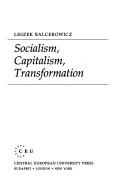
Socialism, Capitalism, Transformation
Insider: the architect of shock therapy setting out his own reasoning.
Summary
Leszek Balcerowicz designed and implemented Poland's 1990 stabilisation programme as finance minister and later served as central bank governor. This volume collects his academic essays on the economics of socialism, on the comparison between systems, and on the transformation process.
The theoretical essays argue that socialist economies fail for systemic reasons rather than through poor implementation, drawing on the socialist calculation debate and on the property rights literature. Balcerowicz's own contribution concerns the political economy of reform: he argues that the period immediately after a regime change offers what he calls extraordinary politics, a window in which the public will accept costly measures that would be impossible later, and that reformers must use it because it closes within months.
The policy essays defend the Polish programme's design: simultaneous price liberalisation, fiscal correction, currency convertibility and trade opening, on the argument that these measures are complementary and that sequencing them reduces the effectiveness of each. He addresses the criticisms directly, including the depth of the output fall and the unemployment that followed. The book is academic in style and assumes economics training. Its most cited contribution is the extraordinary politics argument, which has been applied well beyond the postcommunist context. Balcerowicz is an interested party and the volume is a defence as well as an analysis.
Key takeaways 7
- Socialist economies fail for systemic reasons connected to property rights and information, not through poor implementation.
- The period immediately after a regime change offers a window of extraordinary politics in which costly reforms are politically possible.
- That window closes within months, so reforms not made immediately become far harder or impossible.
- Price liberalisation, fiscal correction, convertibility and trade opening are complementary, and sequencing them weakens each.
- Balcerowicz argues that the measured output fall after 1990 overstated the real decline because prior output included unwanted goods.
- Partial reform creates rents that generate political opposition to completion, which argues for comprehensiveness.
- Institutional development takes years while price liberalisation takes days, and reformers must proceed with the second while building the first.
Who should read it
Economists and policy readers who want the theoretical and political-economy case for rapid transformation from its principal implementer.
Where it sits in the reference 2
Similar books 6
Chosen by shared topics, the entries that hold them, and the people who recommended both.