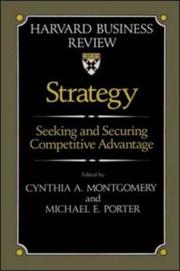
Strategy: Seeking and Securing Competitive Advantage
Edited HBR reader; OL lists title as 'Strategy'
Summary
The reference has not verified this book in detail; the summary states only what the title, author and subject establish.
Michael Porter and Cynthia Montgomery edited this collection of readings for teaching strategy at Harvard Business School. It assembles articles by different authors on industry analysis, competitive positioning, corporate strategy and the sources of advantage.
The contents include Porter's own work on the five forces and on competitive advantage, material on cost and differentiation positioning, work on corporate strategy and diversification including contributions from the resource-based tradition, and material on competitive dynamics and on the sustainability of advantage. The collection reflects the state of the field around 1990, at a point when the industrial organisation approach that Porter represented and the resource-based view that emphasised firm-specific capabilities were both current.
The reference has not verified the specific selection in this volume, and this entry reflects its established purpose as a teaching reader and the editors' known positions rather than a close reading. Readers wanting Porter's argument directly should read On Competition or Competitive Strategy; readers wanting the resource-based view should go to its primary sources.
Key takeaways 6
- Industry structure determines average profitability, and a firm's position within an industry determines its performance relative to that average.
- Competitive advantage comes either from lower cost or from differentiation that customers will pay for, and pursuing both usually achieves neither.
- The resource-based view holds that firm-specific resources that are valuable, rare and hard to imitate explain sustained advantage.
- Corporate strategy creates value only when the parent transfers skills or shares activities across businesses.
- Advantage erodes as competitors imitate, so the question of sustainability is about what makes imitation costly.
- The field around 1990 held two partly competing explanations of performance, one emphasising industry position and one emphasising firm resources.
Who should read it
Students and instructors wanting a teaching collection on competitive strategy from around 1990, with the caveat that this entry is not verified in detail.
About Michael E. Porter
Bishop William Lawrence University Professor Emeritus, Harvard Business School; founder, Institute for Strategy and Competitiveness
Competitive Strategy and the five-forces framework are the primary source for industry analysis, and Competitive Advantage supplied the value-chain vocabulary the field still uses.
Where it sits in the reference 2
Similar books 6
Chosen by shared topics, the entries that hold them, and the people who recommended both.