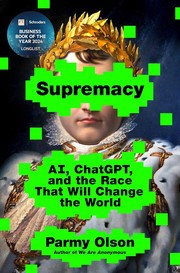
Supremacy
The OpenAI-DeepMind race that set the shape of Nvidia's customer base.
Summary
Olson tracks the parallel development of DeepMind and OpenAI through the personalities of Demis Hassabis and Sam Altman, from DeepMind's founding in 2010 and its 2014 sale to Google, through OpenAI's creation as a non-profit in 2015, the capped-profit restructuring, the Microsoft partnership, the release of ChatGPT, and the board's brief removal of Altman in November 2023.
The argument concerns safety commitments and corporate control. Olson documents that both organisations were founded with explicit safety missions and governance structures intended to prevent commercial pressure from driving deployment, and that both structures were dismantled or bypassed once large-scale capital became necessary. DeepMind's promised independent ethics board never functioned as agreed after the Google acquisition, and OpenAI's non-profit board lost the confrontation with its own commercial arm within days. She reports on the DeepMind health data arrangements with the Royal Free NHS Trust, which regulators found unlawful, and on the internal disagreements that produced Anthropic.
The book is reported journalism based on interviews with participants and former employees, written for a general audience. Its use to investors is as a governance case study: it shows that mission-protecting structures fail under capital dependence, and it documents the specific mechanisms of failure. The limitations are timing and access. It went to press before several later developments, its technical treatment is light, and the two-founder framing compresses a story that involves many other actors and organisations. Olson is a critical observer rather than a neutral one.
Key takeaways 7
- Both DeepMind and OpenAI were founded with governance structures meant to constrain commercial deployment, and both structures failed once the organisations depended on outside capital.
- DeepMind's acquisition by Google included an ethics board commitment that was never implemented as its founders described it.
- OpenAI's conversion from non-profit to capped-profit was the decision that made the November 2023 governance crisis possible.
- Microsoft's investment gave it practical control over OpenAI's direction without formal board representation, through compute dependence and commercial terms.
- The DeepMind arrangement with the Royal Free NHS Trust transferred patient data on a legal basis regulators subsequently found invalid.
- Anthropic was founded by OpenAI staff who concluded that commercial pressure had overridden the safety commitments they had joined for.
- Concentration of frontier model development inside two or three companies is a product of compute cost, and no governance arrangement has yet counteracted it.
Who should read it
Investors and founders who want a reported account of how mission-protecting corporate structures behave when they meet capital dependence.
Where it sits in the reference 4
Who recommended it 1 · 1 direct
Similar books 6
Chosen by shared topics, the entries that hold them, and the people who recommended both.


