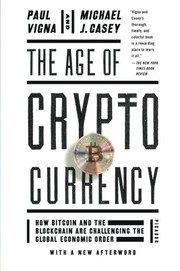
The Age of Cryptocurrency
Wall Street Journal reporters on money, trust and the blockchain claim.
Summary
Paul Vigna and Michael Casey, both Wall Street Journal reporters, wrote one of the first serious journalistic treatments of Bitcoin. It explains the technology, tells the history to 2014, and considers what the system might be for.
The technical explanation covers the double-spending problem that digital cash faced before Bitcoin, the blockchain as a public ledger, proof of work mining and the incentive design that secures it, and public key cryptography as the ownership mechanism. The historical material covers the cypherpunk and digital cash precursors, the Satoshi Nakamoto paper, the early adopters, Mt Gox and its collapse, Silk Road, and the first wave of venture investment in Bitcoin companies.
The authors' framing is monetary history: they place Bitcoin in a long argument about what money is and who controls it, and they take seriously both the claim that a currency without an issuer is valuable and the objections to it. They are also serious about remittances and financial inclusion as the applications most likely to matter. Written in 2014, the book predates Ethereum's launch, the initial coin offering period, decentralised finance, the institutional adoption of the 2020s and the regulatory framework that developed. Its technical explanation remains one of the clearest available and its speculation about applications has largely not been borne out.
Key takeaways 7
- Bitcoin solved the double-spending problem for digital cash by making the ledger public and the right to update it costly.
- Proof of work secures the ledger by making the cost of rewriting history exceed the benefit of doing so.
- The system requires no trusted issuer, which is its distinguishing property and the source of both its appeal and its instability.
- Vigna and Casey place the technology in a long historical argument about who controls money rather than treating it as a technical novelty.
- Mt Gox's collapse demonstrated that the exchange layer reintroduces the trusted intermediaries the protocol was designed to remove.
- The authors identified remittances and financial inclusion as the most promising applications, and neither has developed as predicted.
- The volatility that makes Bitcoin attractive as a speculative asset prevents it functioning as a unit of account.
Who should read it
Readers wanting a clear explanation of how the technology works and of its origins, with awareness that the book stops in 2014.
Where it sits in the reference 2
Similar books 6
Chosen by shared topics, the entries that hold them, and the people who recommended both.


