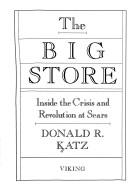
The Big Store: Inside the Crisis and Revolution at Sears
Long-access account of the 1980s restructuring and culture.
Summary
Donald Katz was given extensive access to Sears, Roebuck during the mid-1980s and produced this account of a company attempting to reinvent itself after losing its position as America's dominant retailer.
The historical material covers Sears at its peak, when it sold a substantial share of everything Americans bought, and the sources of that position: the catalogue, the move to suburban stores, the ownership of its suppliers, the Allstate insurance business it created, and the profit-sharing plan that made employees the largest shareholder group. Katz then covers the decline, as discounters and category specialists took share from a general merchandiser whose costs were built for a different competitive era.
The reinvention he covers is Edward Brennan's attempt to make Sears a financial services and retailing conglomerate, adding Dean Witter and Coldwell Banker to Allstate and launching the Discover card, on the theory that the customer relationship could be extended across categories. Katz reports the internal conflicts, the resistance from the retail organisation, and the difficulty of changing a company whose culture had been formed by decades of dominance. The strategy did not work and Sears divested the financial businesses in the 1990s. The book's value is the detailed portrait of a large organisation's internal resistance to change, observed as it happened rather than reconstructed afterward.
Key takeaways 7
- Sears lost share to discounters and category specialists whose cost structures a general merchandiser could not match.
- The company's culture had been formed by decades of dominance and treated competitive threats as temporary.
- Extending a retail customer relationship into financial services assumed a transferable trust that customers did not exercise.
- Sears owned or controlled many of its suppliers, which gave it cost advantages and also locked in obsolete capacity.
- Katz documents that internal resistance to strategic change came from managers whose careers had been built on the old model.
- The Discover card succeeded as a business while failing to produce the cross-selling that justified its creation.
- Employee profit sharing made the workforce the largest shareholder group and did not prevent the decline.
Who should read it
Operators and investors studying incumbent decline and the internal politics of attempted transformation in a large organisation.
Where it sits in the reference 2
Similar books 6
Chosen by shared topics, the entries that hold them, and the people who recommended both.