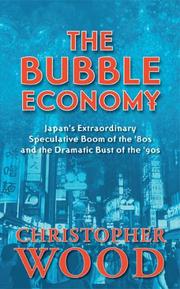
The Bubble Economy
Written from Tokyo as the bubble deflated; the classic contemporaneous account.
Summary
Christopher Wood was a journalist for The Economist in Tokyo and wrote this in 1992, as the Japanese asset bubble was deflating and while most observers still expected a recovery. It is a contemporaneous account with the analysis of a participant in the market.
Wood describes the mechanics of the bubble: the monetary expansion after the 1985 Plaza Accord, the bank lending against land collateral in a system where land values were assumed only to rise, the cross-shareholdings that removed shares from circulation and supported prices, the accounting that let banks count unrealised equity gains toward capital, and the zaitech treasury operations through which industrial companies speculated in financial markets. He explains the specific institutional features that permitted these, including the Ministry of Finance's guidance of the market and the convoy system that prevented any financial institution from failing.
His prediction was that the deflation would be prolonged and that the banking system's losses would be far larger than acknowledged, both of which proved correct and were minority views in 1992. He was less right about the political consequences and about the timing of resolution, which took far longer than he expected. The book is a useful record of what could be seen at the time, and of how a financial system with concealed losses and no mechanism for recognising them behaves.
Key takeaways 7
- Japanese bank lending was secured on land whose value was assumed to rise perpetually, which made the collateral and the loan the same bet.
- Cross-shareholdings removed shares from circulation and supported prices without any underlying valuation.
- Banks counted unrealised equity gains toward regulatory capital, which linked their solvency directly to the stock market.
- Industrial companies used treasury operations to speculate in financial markets, which made their earnings dependent on asset prices.
- The convoy system prevented any financial institution from failing, which removed the mechanism that would have forced loss recognition.
- Wood predicted a prolonged deflation and bank losses far larger than acknowledged, which was a minority view in 1992.
- A financial system with no mechanism for recognising losses defers rather than avoids them, and the deferral itself is costly.
Who should read it
Investors who want a contemporaneous analysis of a major asset bubble deflating, written before the outcome was known.
Where it sits in the reference 2
Similar books 6
Chosen by shared topics, the entries that hold them, and the people who recommended both.