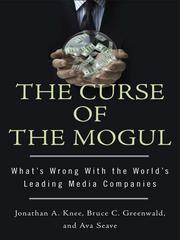
The Curse of the Mogul
Why media scale rarely earns returns; useful on conglomerate logic.
Summary
Knee, Greenwald and Seave attack the premise that media businesses are special. They apply standard competitive strategy analysis, meaning barriers to entry and returns on capital, to the major media conglomerates and find that most of them destroyed shareholder value over decades while their chief executives were celebrated for vision.
The specific claims are that the supposed sources of media advantage do not survive examination. Content is not king, because talent captures the economics of hit content. Scale in content production produces no meaningful cost advantage, because each film or show is a separate production. Vertical integration between content and distribution does not create value, because both sides can transact at arm's length. Global reach adds nothing when the product must be localised. Convergence and synergy have been asserted for thirty years without producing measurable returns. What does work is the ordinary source of advantage in any industry: local or niche scale where fixed costs are spread over a defined market that competitors cannot enter, exclusive control of a distribution bottleneck, and customer captivity. The authors point to trade publications, local newspapers before the internet, cable systems and information databases as the media businesses that actually earned excess returns.
The framework comes from Greenwald's competition analysis work, and the evidence is returns on invested capital across the sector plus transaction case studies. For investors the argument is directly usable and it explains a long run of value-destroying media deals. The book was published in 2009, before streaming reordered the industry, and readers should test whether the streaming platforms represent a genuine counterexample or another round of the same errors. The tone is combative and the authors give little credit to media operators who did build durable positions.
Key takeaways 7
- Media companies have consistently destroyed shareholder value while their executives were praised for strategic vision, and the returns data shows this clearly.
- Content is not a source of durable advantage because the talent that creates hits captures the economics of the hits.
- Vertical integration between content production and distribution creates no value that arm's-length contracting cannot deliver.
- Scale in media only creates advantage when it is local or niche, because that is where fixed costs are spread over a market competitors cannot economically enter.
- Global expansion in media adds cost without advantage, since the product must be recreated for each market.
- The media businesses that earned genuinely high returns controlled a distribution bottleneck or served a captive professional customer base.
- Executive compensation in media is set against peer conglomerates rather than against returns on capital, which perpetuates the value-destroying deal cycle.
Who should read it
Investors and operators in media, entertainment or content businesses who need a hard test of whether a claimed strategic advantage actually exists.
Where it sits in the reference 4
Who recommended it 1
Similar books 6
Chosen by shared topics, the entries that hold them, and the people who recommended both.