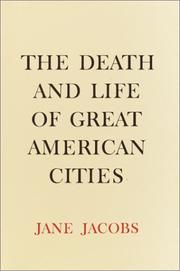
The Death and Life of Great American Cities
Still the founding text on how urban value is actually created.
Summary
Jacobs attacked the urban planning orthodoxy of the 1950s, which favoured separated land uses, superblocks, tower housing in open space and the clearance of neighbourhoods deemed slums. She argued from direct observation that this approach destroyed the conditions that make cities work, and she wrote as a journalist and resident rather than as a planner.
Her central argument is that cities depend on dense, mixed, continuous street activity. She identifies four conditions for diversity: a district must serve more than one primary function so that people are present at different times of day; blocks must be short so that routes intersect and streets are used; buildings must vary in age and condition so that rents vary and different uses are affordable; and density of population must be sufficiently high.
The eyes on the street concept holds that public safety comes from continuous informal observation by people who have reason to be present, not from policing or from design that separates people from streets. She develops the idea of the sidewalk as the site of unplanned contact that builds the trust a neighbourhood runs on. Her attack on urban renewal is specific and she documents projects that destroyed functioning neighbourhoods and produced the conditions they were meant to remove.
Jacobs opposed Robert Moses directly and stopped the Lower Manhattan Expressway. Her framework has been criticised for underweighting the role of housing supply and for having been adopted by residents opposing development, which uses her arguments against the density she advocated. Her observational method has no statistical apparatus, which specialists note. The four conditions remain the standard framework for thinking about urban vitality.
Key takeaways 8
- City districts require mixed primary uses so that people are present at different times of day, since single-use areas empty and become unsafe.
- Short blocks create intersecting routes that put people on more streets, which is what generates the activity a district depends on.
- Buildings of varying age and condition produce varying rents, which is what allows new and marginal businesses to exist.
- Sufficient residential density is a requirement rather than a problem, and the planning profession treated it as the opposite.
- Public safety comes from continuous informal observation by people who have reason to be on the street rather than from policing or from design.
- Repeated casual contact on sidewalks builds the trust that allows a neighbourhood to function, and it cannot be produced by designed community facilities.
- Clearance of neighbourhoods labelled as slums destroyed functioning social and economic networks that no rebuilding replaced.
- Her arguments have been adopted by residents opposing development, which uses them against the density she was arguing for.
Who should read it
Anyone thinking about cities, physical spaces or the conditions that produce unplanned interaction, including people designing offices and campuses.
Where it sits in the reference 1
Who recommended it 5 · 1 direct
Similar books 6
Chosen by shared topics, the entries that hold them, and the people who recommended both.