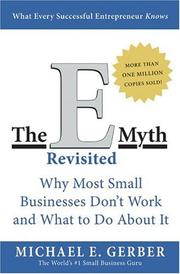
The E-Myth Revisited
Build the business as a replicable prototype; the franchise mindset generalised.
Summary
Gerber argues that most small businesses fail because they are started by technicians who are good at the work and who assume that being good at the work qualifies them to run a business. His central distinction separates three roles: the entrepreneur, who works on the business and sets direction; the manager, who creates order and systems; and the technician, who does the work. He argues that most owners are almost entirely technician and end up owning a job rather than a business.
His prescription is to build the business as if it were the prototype for a franchise, which forces every process to be documented, systemised and executable by someone with ordinary skill. He uses McDonald's as the reference case, arguing that Ray Kroc's real product was the business system rather than the food. The turnkey approach requires an operations manual, defined roles with position contracts, and standards that produce a consistent customer result independent of who performs the work.
The book includes a business development process covering innovation, quantification and orchestration, and it argues that an owner should define their primary aim in life before defining the business's strategic objective, so that the business serves the life rather than the reverse.
The narrative device, a series of conversations with a pie shop owner named Sarah, is repetitive and the book is padded to length. The advice fits service businesses and small operations with repeatable processes, and fits poorly with businesses whose value comes from judgment, creativity or specialised expertise. The systemisation argument is sound and widely applied. The franchise prototype framing is the reason people remember it.
Key takeaways 8
- Most small businesses are started by technicians who assume that skill at the work qualifies them to run a business, which is the source of the failure rate.
- An owner who works only inside the business owns a job rather than a business, and the difference is whether it can operate without them.
- A business should be built as if it were the prototype for a franchise, which forces documentation of every process before it is needed.
- Systems should be designed so that people with ordinary skill produce consistent results, rather than relying on hiring exceptional people.
- The owner should define what they want from their life first, and then design a business that produces it.
- Every role should have a written position contract stating the result it produces, the work involved and the standards, including roles the owner currently fills.
- Business development runs on innovation, quantification and orchestration, and quantification is the step most owners skip.
- Working on the business rather than in it requires scheduled time that must be protected, because operational demands will consume it otherwise.
Who should read it
Owners of small service businesses who are the bottleneck in their own operation and need to document and delegate before they can grow.
Where it sits in the reference 2
Who recommended it 9
Similar books 6
Chosen by shared topics, the entries that hold them, and the people who recommended both.
