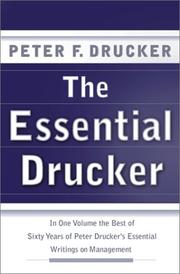
The Essential Drucker
Anthology selected from sixty years of writing
Summary
Peter Drucker selected these twenty-six chapters from his own books published between 1954 and 1999, and the volume is intended as a single-book introduction to his work. He wrote the introduction and chose the selections himself.
The organisation is in three parts. The first covers management as a discipline, including the purpose of a business, the manager's tasks, management by objectives, and the management of non-profit and public institutions. The second covers the individual, including effectiveness, decision-making, and the managing oneself material. The third covers society, including the knowledge society, the changing workforce, and the corporation's social position.
As an introduction it works better than the collections of journalism, because the selections are drawn from the books where Drucker developed arguments rather than from newspaper columns. It is also the most efficient way to establish which of his books to read in full. Its limitation is the limitation of all anthologies: the arguments are separated from the surrounding development that supports them, and a reader who finds one persuasive will need the source book to see the reasoning.
Key takeaways 7
- The purpose of a business is to create a customer, which makes marketing and innovation the only functions that produce results.
- Effectiveness is a set of learnable habits rather than a talent, and Drucker specifies what they are.
- Managers should be directed by objectives they helped set and controlled by measuring their own results against them.
- Knowledge workers own their means of production and must be managed as volunteers rather than as subordinates.
- Every organisation should systematically abandon what it would not start today.
- Service institutions perform badly because they are paid from budgets rather than from results.
- Decisions should begin by establishing whether the situation is generic, which requires a rule, or genuinely unique, which requires a decision.
Who should read it
Readers who want one book covering Drucker's range, selected by him, before deciding which full works to read.
About Peter F. Drucker
Management writer and consultant; professor at Bennington, NYU and Claremont Graduate University
He invented management as a field of study, and The Practice of Management and The Effective Executive remain the primary sources every later writer builds on.
Where it sits in the reference 2
Similar books 6
Chosen by shared topics, the entries that hold them, and the people who recommended both.





