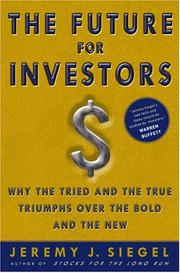
The Future for Investors
Dividend reinvestment as the bear market protector and return accelerator.
Summary
Siegel argues that investors systematically overpay for growth and that the highest long-run returns have come from established companies in mature or declining industries that were priced low and paid dividends which were reinvested.
His central evidence is a study of the original 1957 Standard and Poor's 500 constituents held to 2003. He finds the best performer over that period was Philip Morris, a company in a shrinking, litigated, heavily taxed industry, and that the portfolio of original constituents held without change outperformed the continuously updated index. His explanation is what he calls the growth trap: investors bid up companies and sectors with visible growth prospects to prices that impound more growth than is delivered, while ignored companies with low expectations deliver returns above their price implies. Dividend reinvestment is the mechanism, since a low-priced stock's reinvested dividends buy more shares, which he calls the bear market protector and return accelerator.
He extends this to new issues, arguing that initial public offerings as a class have underperformed, and to sectors and countries, arguing that the fastest-growing economies have not produced the best equity returns.
The second half of the book concerns demographics, arguing that ageing populations in developed countries will need to sell assets to fund retirement and that buyers will come from developing economies. That argument is speculative and has not played out as described.
The study methodology has been criticised, particularly on survivorship and on the treatment of spin-offs and mergers among the original constituents. The growth trap finding is consistent with the broader value literature.
Key takeaways 7
- Investors systematically overpay for visible growth, so companies with high expected growth deliver lower returns than their prospects suggest.
- The original 1957 Standard and Poor's 500 constituents held unchanged to 2003 outperformed the continuously updated index.
- Dividend reinvestment is the primary mechanism of long-run equity return, and it works most powerfully in stocks whose prices stay low.
- Initial public offerings as a class have underperformed the market, because they are sold when the seller's information advantage is greatest.
- The fastest-growing economies have not produced the best equity returns, because growth expectations are already reflected in the prices paid.
- A company in a declining industry can be an excellent investment if its price impounds a worse outcome than it delivers.
- Sector growth and shareholder return are independent, since new capital entering a growing sector competes away the returns.
Who should read it
Long-horizon equity investors who want the empirical case against paying for growth and for dividend reinvestment as the source of return.
About Jeremy Siegel
Russell E. Palmer Professor Emeritus of Finance, The Wharton School; senior economist / investment strategy adviser to WisdomTree
Stocks for the Long Run assembled the long-run US return series that later writers reuse, though its equity-premium conclusions remain contested.
Where it sits in the reference 3
Who recommended it 1 · 1 direct
Similar books 6
Chosen by shared topics, the entries that hold them, and the people who recommended both.

