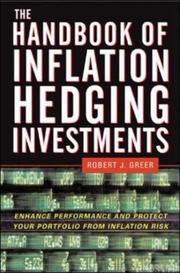
The Handbook of Inflation Hedging Investments
Linkers set beside commodities and real assets as competing inflation hedges.
Summary
Robert Greer edited this volume of contributions from practitioners on assets and strategies intended to protect portfolios against inflation. Greer's own work on commodity indices, including the original construction of a commodity total return index, sits behind the collection.
The chapters cover the candidate hedges individually. Inflation-linked government bonds, whose mechanics and pricing are covered along with the difference between breakeven rates and expected inflation. Commodities and commodity index investment, including the decomposition of returns into spot, roll and collateral components, which is Greer's own contribution and which explains why a commodity index return differs from commodity price appreciation. Real estate and its lease structures. Natural resource equities and their imperfect relationship to the underlying commodities. Timber and farmland. Infrastructure. Inflation derivatives including swaps and options.
The volume is a practitioner reference and its authors are generally advocating the asset classes they manage, which readers should weigh. It was published in 2005, before the commodity index inflows of the following years compressed roll returns, before the 2008 collapse, and before the inflation of 2021 and 2022 provided a real test. That test broadly supported commodities and inflation-linked bonds with short duration, and did not support real estate equities or natural resource equities, which is worth setting against the volume's claims.
Key takeaways 7
- Commodity index returns decompose into spot return, roll return and collateral return, and only the first tracks commodity prices.
- Roll return turns negative when futures curves are in contango, which can make an index lose money while prices rise.
- Inflation-linked bonds hedge inflation only over horizons matching their duration, and longer issues carry real rate risk that dominates.
- Natural resource equities correlate with equity markets more than with the commodities they produce, which weakens their hedging value.
- Real estate hedges inflation only where lease structures permit rents to reset, which varies enormously by property type and jurisdiction.
- Breakeven inflation rates contain risk and liquidity premia and are therefore biased estimates of expected inflation.
- Contributors are generally advocating asset classes they manage, which readers should weigh against the analysis.
Who should read it
Institutional investors assembling inflation protection who want a survey of the candidate assets and the mechanics of each.
Where it sits in the reference 2
Similar books 6
Chosen by shared topics, the entries that hold them, and the people who recommended both.