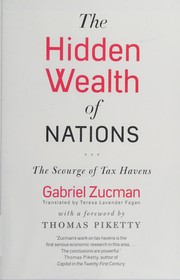
The Hidden Wealth of Nations
The measurement of offshore wealth, much of it booked in Switzerland.
Summary
Zucman, an economist, wrote a short book estimating how much household financial wealth is held offshore and setting out what could be done about it.
The methodological contribution is the estimation technique. Zucman uses a discrepancy in international investment statistics: if every country's reported foreign assets and liabilities were accurate, global assets would equal global liabilities. They do not. The world reports more liabilities than assets, which means securities are recorded as owed by someone to nobody. Zucman argues that this gap corresponds to wealth held through offshore intermediaries where the ultimate owner is not recorded, and uses it to estimate the offshore total at roughly eight per cent of global household financial wealth, around seven and a half trillion dollars at the time of writing, with the share substantially higher for Russia, the Gulf and Latin America than for Europe or the United States.
The historical sections trace Swiss banking secrecy from the 1920s, the growth of Luxembourg, the Caribbean centres and Singapore, and the mechanisms: shell companies, trusts, nominee arrangements and the fictitious relocation of profits by multinationals.
His policy proposals are specific. A global financial registry recording the ultimate owner of every security, built from the existing central securities depositories. Automatic exchange of information with verification rather than voluntary compliance. Trade sanctions against non-cooperating jurisdictions, calculated so that the cost exceeds the revenue those jurisdictions earn from secrecy. A unitary tax on multinationals apportioning profit by sales rather than by declared location.
The estimates depend on the assumption that the statistical gap is entirely offshore wealth, which other researchers dispute, and the figures have been revised in later work. The registry proposal has partly advanced through the Common Reporting Standard and beneficial ownership registers, with mixed enforcement.
Key takeaways 7
- Global reported financial liabilities exceed reported assets, and the gap corresponds to wealth held through unrecorded offshore intermediaries.
- Roughly eight per cent of global household financial wealth is held offshore, with the share far higher for Russia, the Gulf and Latin America.
- Offshore wealth is not physically located in tax havens; the assets sit in normal markets while the ownership record is broken in the haven.
- A global registry of securities ownership could be built from existing central securities depositories rather than created new.
- Automatic information exchange without verification fails, because the reporting depends on the jurisdiction that profits from secrecy.
- Trade sanctions calculated to exceed a haven's earnings from secrecy would change the calculation for small jurisdictions.
- Apportioning multinational profit by sales rather than by declared location would remove the value of shifting profits to low-tax jurisdictions.
Who should read it
Investors, advisers and policy readers who want a quantitative estimate of offshore wealth and a concrete enforcement proposal.
Where it sits in the reference 3
Similar books 6
Chosen by shared topics, the entries that hold them, and the people who recommended both.