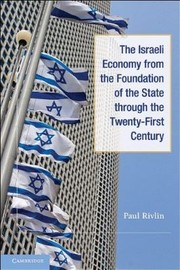
The Israeli Economy from the Foundation of the State through the 21st Century
The wider economy: labour markets, defence spending, inflation and stabilisation.
Summary
Paul Rivlin, an economist at Tel Aviv University, traces the Israeli economy from the state's founding in 1948 through the first decade of the twenty-first century.
The periods he covers have distinct economic characters. The early decades involved absorbing mass immigration, building infrastructure, and a highly directed economy with substantial state and Histadrut ownership, funded partly by German reparations and by diaspora transfers. The 1970s brought the cost of the 1973 war, rising defence expenditure and accelerating inflation. The 1980s brought hyperinflation reaching several hundred per cent annually and the 1985 stabilisation programme, which combined fiscal correction with a temporary wage and price freeze and an exchange rate anchor and is regarded as a successful heterodox stabilisation. The 1990s brought Soviet immigration on a scale that increased the population by roughly a fifth, and the liberalisation that followed. The 2000s brought the technology sector's growth and the second intifada's economic cost.
Rivlin covers the structural issues throughout: defence spending as a share of output, the labour force participation of the ultra-Orthodox and Arab populations, income inequality, and the concentration of ownership in Israeli business groups. The book is an economic history rather than an argument and is the standard single-volume account. Readers wanting a critical assessment of the technology sector should add David Rosenberg's work.
Key takeaways 7
- Israel's early economy was highly directed, with substantial state and labour federation ownership, funded partly by reparations and diaspora transfers.
- The 1985 stabilisation combined fiscal correction, a temporary wage and price freeze and an exchange rate anchor, and ended hyperinflation quickly.
- Soviet immigration in the 1990s raised the population by roughly a fifth and supplied engineers who staffed the technology sector.
- Defence expenditure has consumed a share of Israeli output far above any comparable economy throughout the country's history.
- Low labour force participation among ultra-Orthodox and Arab populations constrains aggregate productivity and creates a fiscal problem.
- Israeli business ownership is concentrated in a small number of groups, which limits competition in domestic sectors.
- The technology sector's growth after the 1990s did not raise productivity in the rest of the economy.
Who should read it
Investors and analysts working on Israel who want the full economic history, including the stabilisation programme that ended hyperinflation.
Where it sits in the reference 2
Similar books 6
Chosen by shared topics, the entries that hold them, and the people who recommended both.