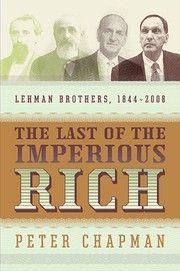
The Last of the Imperious Rich: Lehman Brothers, 1844-2008
The long institutional history, cotton broker to bankruptcy.
Summary
Peter Chapman, a Financial Times editor, wrote the long history of Lehman Brothers from its founding as a cotton brokerage in Montgomery, Alabama in 1844 through its bankruptcy in 2008.
The historical material is the book's contribution, since most accounts of Lehman begin in the 1980s. Chapman covers the firm's origins in cotton trading, its move to New York after the Civil War, its role in the New York Cotton Exchange, its entry into securities underwriting in partnership with Goldman Sachs in the early twentieth century, and its financing of retailers, film companies and airlines. He covers the Bobbie Lehman era, the partnership's culture, and the conflict between bankers and traders that ran through its later history and produced the sale to American Express in 1984.
The modern material covers the 1994 spin-off, Richard Fuld's leadership, the growth of the fixed income and real estate businesses, and the collapse. Chapman's argument is that the firm's history was one of recurring internal conflict resolved by whichever faction was making money at the time, and that this pattern produced both its resilience and its final concentration in commercial real estate. The book is journalism rather than archival scholarship and the modern chapters cover ground better treated elsewhere. The nineteenth and early twentieth century material is not available in this form anywhere else.
Key takeaways 7
- Lehman began as a cotton brokerage in Alabama and moved into securities through its commodity trading relationships.
- The firm financed retailers, film companies and airlines when established banks would not, which defined its position for decades.
- Internal conflict between bankers and traders recurred throughout the firm's history and was resolved by whoever was earning most.
- The 1984 sale to American Express followed an internal conflict that the partnership could not resolve.
- Chapman argues that the firm's culture of internal competition produced both its resilience and its final concentration in real estate.
- The partnership structure disciplined risk-taking in ways that the public company that followed did not replicate.
- The nineteenth and early twentieth century material is the book's distinctive content, since other accounts begin in the 1980s.
Who should read it
Readers of financial history who want the full institutional history of Lehman rather than another account of its final years.
Where it sits in the reference 2
Similar books 6
Chosen by shared topics, the entries that hold them, and the people who recommended both.