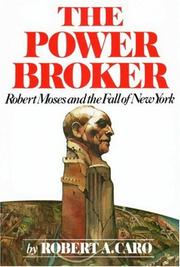
The Power Broker
Robert Moses and the politics of who gets to build and toll public assets.
Summary
Caro spent seven years on this biography of Robert Moses, who held appointed rather than elected positions in New York for forty-four years and built the parkways, bridges, expressways, parks, housing projects and public authorities that shaped the modern city and its suburbs. The book runs over one thousand two hundred pages and Caro conducted more than five hundred interviews.
The central subject is how power is acquired and exercised without election. Moses drafted the legislation creating public authorities and wrote provisions that others did not read, giving those authorities the power to issue bonds. Bondholder contracts then became legally protected obligations that the state could not override, which made Moses effectively immune to elected officials. Toll revenue from the Triborough Bridge Authority funded further construction without legislative appropriation, and the bonds outlasted every governor and mayor.
Caro documents the consequences directly. Moses displaced roughly half a million people for expressway construction, destroyed the Bronx neighbourhood of East Tremont through the Cross Bronx Expressway, refused to include mass transit provision in his highways, and built parks and pools in ways that reflected his views about who should use them. The book is also a study of how an early idealist reformer became what he became. Caro traces the change to the discovery that principle without power accomplishes nothing.
The length is a real obstacle. Some historians argue Caro overstates Moses' personal responsibility relative to broader postwar planning consensus, and the racial motivation attributed to specific decisions, including the bridge heights on the Southern State Parkway, has been questioned. It remains the definitive study of institutional power exercised outside electoral accountability.
Key takeaways 8
- Moses acquired durable power by drafting the legislation that created public authorities and inserting provisions nobody else read closely.
- Bond covenants gave his authorities legal protections that elected officials could not override, which made him effectively unremovable for decades.
- Toll revenue funded further construction without legislative appropriation, so the organisation financed its own expansion outside the budget process.
- Starting a project and then requiring additional funds to avoid wasting what was spent is a reliable method for forcing approval of expenditure nobody authorised.
- Moses refused to include mass transit in his highway designs, which shaped the region's transportation dependency permanently.
- Roughly half a million people were displaced by his projects, and the routing decisions in specific cases could have avoided occupied neighbourhoods.
- He began as a reformer and concluded that principle without power achieves nothing, which Caro presents as the decisive change in him.
- Physical infrastructure decisions lock in patterns of settlement and movement for a century, long after the person who made them has gone.
Who should read it
Anyone who wants to understand how durable institutional power is constructed outside electoral accountability, prepared for a very long book.
Where it sits in the reference 3
Who recommended it 8 · 4 direct
Similar books 6
Chosen by shared topics, the entries that hold them, and the people who recommended both.