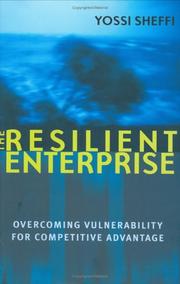
The Power of Resilience
Deep-tier supply-chain risk, a decade on.
Summary
Yossi Sheffi directs the MIT Center for Transportation and Logistics and wrote this as a successor to The Resilient Enterprise, extending the analysis with a decade of further cases including the 2011 Japanese earthquake and Thai floods.
The analytical framework classifies disruptions by probability and impact, and argues that the ones that matter are the low-probability high-impact events that no forecasting process will identify in advance. The response is therefore to build capabilities that work regardless of what happens rather than to predict specific events.
The operational content is specific. Sheffi covers deep tier mapping, meaning knowing not just direct suppliers but their suppliers, since the 2011 events showed that companies were exposed through components they did not know they bought; the distinction between redundancy, which is inventory and spare capacity and costs money continuously, and flexibility, which is the ability to shift production between sites and products and costs less but requires investment in standardisation and in relationships; the detection problem, meaning how quickly a firm learns that a disruption has occurred; the response organisation and the value of practised procedures; and the specific cases including Intel, Cisco, Toyota, Ford and Nissan, whose divergent responses to the same 2011 events he compares directly. He also covers reputational and social risks in supply chains, including labour conditions and environmental exposure. The book is practical and case-based and is the standard reference for supply chain risk.
Key takeaways 7
- Low-probability high-impact disruptions cannot be forecast individually, so firms should build capabilities rather than predictions.
- Deep tier mapping is necessary because firms are exposed through components bought by their suppliers' suppliers.
- Redundancy costs money continuously while flexibility costs less and requires investment in standardisation and relationships.
- Detection speed determines the size of the eventual loss, since a firm that learns late has fewer options.
- Firms with practised response procedures recovered from the 2011 events far faster than firms improvising.
- Sheffi compares Toyota and Nissan's responses to the same 2011 disruption and attributes the difference to prior investment in flexibility.
- Supplier relationships built before a crisis determine who gets allocated scarce components during one.
Who should read it
Operators responsible for supply chains and investors assessing operational risk who want specific capabilities rather than risk registers.
Where it sits in the reference 2
Similar books 6
Chosen by shared topics, the entries that hold them, and the people who recommended both.