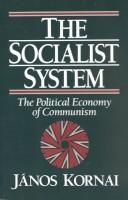
The Socialist System: The Political Economy of Communism
The definitive anatomy of the command economy, by the Hungarian economist who named its pathologies.
Summary
Kornai, a Hungarian economist who spent his career analysing the system he lived under, wrote the definitive theoretical account of how classical socialist economies actually worked.
The method is to treat the system as coherent rather than as a defective market economy. Kornai argues that all its characteristics follow from one structural fact: the undivided power of the communist party, which produces state ownership of the means of production, which produces bureaucratic coordination in place of market coordination, which produces the specific behaviour of firms and households.
The central mechanism is the soft budget constraint. A state firm that loses money is not permitted to fail; it is rescued through subsidies, credit, tax remission or price adjustment. The firm therefore does not treat its budget as binding, so it has unlimited demand for inputs and investment and no incentive to reduce cost. Aggregate demand for inputs consequently exceeds supply at any price, which produces chronic shortage. Shortage is not a temporary imbalance but the system's normal condition, and Kornai traces its consequences: queuing, hoarding by firms, forced substitution by consumers, vertical integration by firms trying to secure their own inputs, quality deterioration since sellers face no competition, and the sellers' market that inverts the relationship between producer and customer.
He also analyses investment hunger and forced growth, the labour shortage that coexists with underemployment, paternalism in the state's relationship with citizens, and the systematic reasons reform attempts fail: partial marketisation leaves the soft budget constraint intact, so market signals are ignored.
The book was published in 1992 as the system was collapsing, drawing on Kornai's earlier work including Economics of Shortage. It is long and analytical rather than historical. The soft budget constraint concept has been applied since to banking rescues, state enterprises in mixed economies and subsidised sectors generally, which is where its current relevance sits.
Key takeaways 7
- Every characteristic of the classical socialist system follows from undivided party power through state ownership to bureaucratic coordination.
- A state firm whose losses are always covered treats its budget as soft, so it has unlimited demand for inputs and investment.
- Chronic shortage is the normal condition of such a system rather than a temporary failure of planning.
- Shortage causes firms to hoard inputs and to integrate vertically, which reduces efficiency further and deepens the shortage.
- A permanent sellers' market removes any incentive for quality improvement or customer responsiveness.
- Partial reform fails because market signals cannot direct behaviour while the budget constraint remains soft.
- The soft budget constraint applies wherever an organisation expects rescue, which makes the concept relevant well beyond socialist economies.
Who should read it
Economists and investors who want the analytical framework for state-owned enterprise behaviour and the soft budget constraint, which applies far beyond its original subject.
Where it sits in the reference 3
Similar books 6
Chosen by shared topics, the entries that hold them, and the people who recommended both.