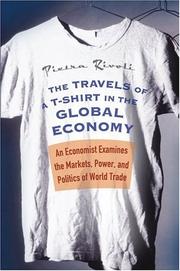
The Travels of a T-Shirt in the Global Economy
One garment traced through every outsourced link in its chain.
Summary
Rivoli, a business school professor, bought a t-shirt in Florida and traced its supply chain backward and forward: to the cotton farm in Texas that grew the fibre, to the Chinese factory that spun and sewed it, through the trade quotas and tariffs that governed its entry into the United States, and finally to the used clothing markets in Tanzania where American donations are resold.
Her central finding contradicts both sides of the globalisation argument. The American cotton industry's dominance, she shows, comes not from free market efficiency but from two centuries of government support: land policy, subsidised water, publicly funded research, marketing programmes and direct payments, on top of a historical labour system built on slavery and sharecropping. The Chinese apparel industry's growth was similarly shaped by state policy. And the trade in both directions has been governed by quota systems, principally the Multifibre Arrangement, that had nothing to do with comparative advantage and everything to do with domestic political bargains.
Her conclusion about factory labour is nuanced. She argues the women working in Chinese apparel factories were better off than their alternatives and that the work was a stage in a transition that had occurred in every industrialising country, while documenting the conditions without minimising them.
The final section on the used clothing trade shows a genuinely free market operating, with entrepreneurial sorting and pricing, and Rivoli notes the irony that the only unregulated stage of the chain is the one nobody argues about. The book is from 2005 and the Multifibre Arrangement expired that year.
Key takeaways 7
- American cotton dominance rests on two centuries of government support including land policy, subsidised water, public research and direct payments rather than on market efficiency.
- Apparel trade has been governed by quota systems reflecting domestic political bargains rather than by comparative advantage.
- Quota systems produced perverse outcomes including production shifting to countries chosen for their unused quota allocations rather than for their efficiency.
- Women working in Chinese apparel factories were better off than in their available alternatives, which is a claim about the alternatives rather than about the conditions.
- Every industrialised country passed through a stage of low-wage textile manufacturing, and the sequence has been consistent enough to be predictive.
- The used clothing trade to Africa is the only genuinely unregulated stage of the chain and operates as a competitive entrepreneurial market.
- Both the free trade and anti-globalisation positions misdescribe the industry, because neither accounts for how much of it is determined by government policy.
Who should read it
Readers who want a concrete supply chain traced end to end and a demonstration of how much of global trade is determined by policy rather than by advantage.
Where it sits in the reference 4
Similar books 6
Chosen by shared topics, the entries that hold them, and the people who recommended both.