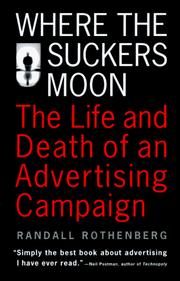
Where the Suckers Moon
One agency account, followed in forensic detail.
Summary
Rothenberg followed Subaru of America through its 1991 advertising agency review and the campaign that followed, with access to both the client and the agencies. The company had built its American position on inexpensive four-wheel-drive cars sold to a distinct niche, then lost its way as competitors added all-wheel drive and as the yen appreciated.
The book documents the agency review in detail, including the pitch process, the relationships and the politics, and the selection of Wieden and Kennedy, then known almost entirely for Nike. The resulting campaign attacked the conventions of car advertising directly, refusing to show cars being driven on mountain roads and instead running commercials in which a copywriter talked about how car advertising lies. It failed commercially. Sales continued to fall, the relationship broke down, and Subaru moved on.
Rothenberg uses the case to make an argument about the advertising business. He shows that agencies sell a product whose effect cannot be measured with confidence, that client organisations therefore buy on relationships and internal politics, and that creative reputation is a currency that circulates within the industry rather than a proxy for commercial results. He also documents the structural economics: the commission system, the consolidation of agencies into holding companies, and the resulting misalignment between what agencies were paid for and what clients needed.
The book is long and closely reported, which is its strength and its difficulty. It is a case study of a single failed campaign, and the generalisations rest on that case plus Rothenberg's reporting on the industry. It predates digital advertising entirely, so the measurement problem it describes has changed shape substantially, though the underlying question of what advertising does has not been settled.
Key takeaways 7
- Advertising effectiveness cannot be measured with confidence, so agencies are selected on relationships and reputation instead.
- Creative reputation circulates as currency inside the advertising industry and correlates weakly with client sales.
- Subaru's position depended on a niche that disappeared once mainstream manufacturers added all-wheel drive.
- A campaign that attacks the conventions of its category wins industry admiration without necessarily moving product.
- The agency review process forces incumbents to compete on presentation rather than on accumulated knowledge of the client.
- Commission-based agency compensation rewarded media spending rather than results, which shaped what agencies recommended.
- Client-side marketing decisions are driven by internal political needs at least as much as by analysis of the market.
Who should read it
Marketers and founders buying agency services who want a detailed account of how the selection process and the incentives actually work.
Where it sits in the reference 2
Who recommended it 1
Similar books 6
Chosen by shared topics, the entries that hold them, and the people who recommended both.