 H
Podcast · 10 episodes in the reference, 2021 to 2025
Honestly with Bari Weiss
Published by The Free Press
Episodes
| What to Expect in 2026 with Niall Ferguson, John McWhorter, Dr. Mark Hyman, Leandra Medine Cohen, Suzy Weiss, and Sarah Isgur | Niall Ferguson | 31 December 2025 | 2:29 | This past year wasn’t easy—but it was certainly eventful. Donald Trump returned to the White House, issued a record number of executive orders, deployed the National Guard to American cities—like LA and D.C.—imposed sweeping tariffs on all our trading partners, gutted the government with the Department of Government Efficiency (DOGE), and unleashed a massive crackdown on immigration. But that was only the beginning. The administration also reached a ceasefire between Israel and Hamas—and all the living hostages came home from Gaza. Israel and the United States struck Iran’s nuclear sites. We got the first American pope. And we haven’t even started listing the pop-culture moments, like the Sydney Sweeney jeans ad, the Travis Kelce–Taylor Swift engagement, or when Lauren Sánchez Bezos and Katy Perry went to space. There was truly so much, and if we kept going we’d be here all day. But this, after all, is a prediction episode. So what will 2026 bring? Bari and Free Press deputy editor Olly Wiseman called up some friends of the pod—and experts in their fields—to get a better sense of what’s in store for the year ahead. They spoke to political analyst and legal expert Sarah Isgur, who told them what to expect in Trump’s second year; to Suzy Weiss on the cultural calendar ahead; to linguist John McWhorter on how new words and language will evolve; to Dr. |
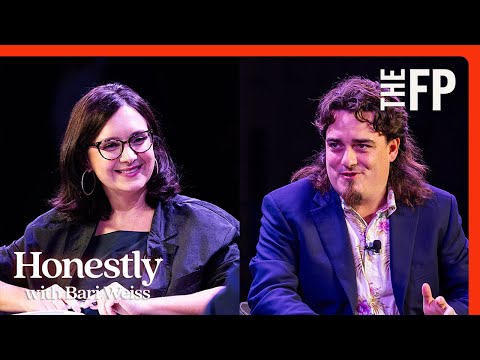 Palmer Luckey and the Future of American Power | Palmer Luckey | 28 October 2025 | 1:30 | A former Senate staffer recently told our friend, reporter Dexter Filkins: “The last socialist systems in the world are in Cuba and the Pentagon.” My guest tonight is trying to do something about that. And good luck to anyone trying to get in his way. When people think of defense tech titans, they might not think of my guest tonight, Palmer Luckey. He looks more like Jimmy Buffett than George S. Patton. But don’t let his looks deceive you. At the age of 19, Palmer founded the VR company Oculus. Two years later, it was acquired by Facebook for more than two billion dollars. Then, when he was 24—while his peers were making dating apps and platforms to share thirst traps—he founded Anduril Industries, having had no experience whatsoever in the world of defense. Now it’s a $30.5 billion company that develops drones, autonomous vehicles, subs, rockets, and software for military use. At just 33, Palmer spends his days building the most technologically advanced software and war-fighting devices in the world. His goal is straightforward: “Move fast, build what works, and get it into the hands of people who need it.” And the moment could not be more critical. Iran is trying to destabilize the Middle East. Russia is willing to lose countless soldiers to gain slivers of territory in Ukraine. China is gaming how to invade Taiwan—to say nothing of our intensifying cold war and AI arms race. And the West’s enemies are undermining us from without and within. |
 Who Will Win the Israel-Iran War? | Niall Ferguson, Bari Weiss, and Dexter Filkins | Niall Ferguson | 16 June 2025 | 1:08 | It’s the fourth day in the war between Iran and Israel. Many questions hang in the air. Chief among them: Will Israel be able to fulfill its main goal in the war—to end Iran’s nuclear program? Will it put troops on the ground to do so, specifically to blow up Iran’s most important nuclear site? Or will the U.S. get involved? Will Trump provide the bunker-busting bombs necessary to destroy the facility at Fordow? Will the regime fall—and if so, what will come next? How does this struggle fit into the much, much larger geopolitical conflict between the U.S. and China? So today, I have two experts to break it all down: Niall Ferguson and Dexter Filkins. Niall Ferguson is a historian and Free Press columnist who just wrote in our pages, “Israel’s attack restores the credibility of the West.” Dexter Filkins is a longtime foreign correspondent who has reported from Iran. He is a contributor at The New Yorker , has covered this topic for years, and is the author of The Forever War . Visit clearme.com/honestly for two months free! Learn more about your ad choices. Visit megaphone.fm/adchoices |
 October 7 and Our Changed World | Niall Ferguson & Bari Weiss | Niall Ferguson | 10 April 2025 | 1:08 | If your head has been spinning since Donald Trump walked into the White House Rose Garden and declared “Liberation Day” last Wednesday, we don't blame you. And not just because it was nauseating watching the stock market or your 401(k) crash down, but because it wasn't clear what exactly we were looking at. As our guest today, economic historian and Free Press columnist Niall Ferguson, wrote in our pages last week: "Depending on your worldview, you probably think Trump’s tariff blitz is one of two things. Either a committed protectionist is trying to Make America Great Again by killing “globalism,” ending “forever wars,” and bringing manufacturing jobs back to the United States. Let’s call this Project Minecraft. Alternatively, an unhinged demagogue is crashing both the world economy and the liberal international order, mainly to the advantage of authoritarian regimes…But here is what is actually happening: The American empire that came into existence after the failed autarky and isolationism of the 1930s is being broken up after 80 years. Despite Trump’s imperial impulses—wanting to annex Greenland, calling for Canada to become the 51st state—he is engaged right now in a kind of wild decolonization project." Whether or not you agree with Niall’s conclusion, there’s no question that the real story here is not about the particular tariff rate for Cambodia or Taiwan; rather, it’s fundamentally about reordering America’s place in the world. |
 Inside Trump's Crypto Revolution | Brian Armstrong | Brian Armstrong | 27 February 2025 | 1:13 | Have you ever gone on the internet and stumbled onto this combo of words, or perhaps non-words?: “Dogecoin.” “Shiba Inu.” “Hawkcoin.” “Bored Ape NFT.” If that sounded like gibberish, don’t worry—we’ll explain. And also, time to start learning, because these terms come out of a new financial ecosystem—the world of crypto, a market that started 15 years ago and is now worth about $3.3 trillion. This new world has caught the attention of none other than President Donald Trump. Since coming to office, Trump has appointed a crypto czar and floated the idea of a national crypto stockpile . And shortly Trump took office, he launched his own meme coin—as did Melania. Trump’s coin has reportedly generated $100 million in trading fees so far. And to top it all off, Trump is taking calls from the biggest names in the business. One of whom is our guest today—Brian Armstrong. Brian is a 42-year-old San Jose native who changed the nature of commerce not only in America but all over the world. He co-founded a cryptocurrency platform called Coinbase in 2012. Now, it’s the largest crypto exchange in the US. To some, he’s doing something as revolutionary as building rocket ships to Mars. To others, he’s growing an industry riddled with scammers, grifters, and criminals. Armstrong says those stories are the sideshow and that Bitcoin—or perhaps another cryptocurrency—will prove itself to be as essential as the dollar. |
 Marc Andreessen on AI, Tech, Censorship and Dining With Trump | Marc Andreessen | 10 December 2024 | 1:44 | Democrats once seemed to have a monopoly on Silicon Valley. Perhaps you remember when Elon Musk bought Twitter and posted pictures of cabinets at the old office filled with “#StayWoke” T-shirts . But just as the country is realigning itself along new ideological and political lines, so is the tech capital of the world. In 2024, many of the Valley’s biggest tech titans came out with their unabashed support for Donald Trump. There was, of course, Elon Musk . . . but also WhatsApp co-founder Jan Koum; Cameron and Tyler Winklevoss, who run the cryptocurrency exchange Gemini; VCs such as Shaun Maguire, David Sacks, and Chamath Palihapitiya; Palantir co-founder Joe Lonsdale; Oculus and Anduril founder Palmer Luckey; hedge fund manager Bill Ackman; and today’s Honestly guest, one of the world’s most influential investors and the man responsible for bringing the internet to the masses—Marc Andreessen. Marc’s history with politics is a long one—but it was always with the Democrats. He supported Democrats including Bill Clinton in 1996, Al Gore in 2000, and John Kerry in 2004. He endorsed Barack Obama in 2008 and then Hillary Clinton in 2016. But over the summer, he announced that he was going to endorse and donate to Trump. Public records show that Marc donated at least $4.5 million to pro-Trump super PACs. Why? |
 Peter Thiel on the Triumph of the Counter-Elites | Peter Thiel | 14 November 2024 | 1:54 | On Tuesday night, president-elect Donald Trump announced that the richest man in the world, Elon Musk, along with entrepreneur Vivek Ramaswamy will head a new initiative in the Trump administration: the Department of Government Efficiency, or “DOGE.” Aside from the very strange fact that internet meme culture has now landed in the White House— Dogecoin is a memecoin —more importantly, what the announcement solidifies is the triumph of the counter-elite. A bunch of oddball outsiders ran against an insular band of out-of-touch elites supported by every celebrity in Hollywood—and they won. And they are about to reshape not just the government but also the culture in ways we can’t imagine. And there was one person I wanted to discuss it with. He is the vanguard of those antiestablishment counter-elites: Peter Thiel. People describe the billionaire venture capitalist in very colorful terms. He’s been called the most successful tech investor in the world. A political kingmaker. The bogeyman of the left. The center of gravity in Silicon Valley. There’s the “Thielverse,” “Thielbucks,” and “Thielists.” To say he has an obsessive cult following would be an understatement. If you listened to my last conversation with Thiel a year and a half ago on Honestly , you’ll remember that Peter was the first guy in Silicon Valley to publicly embrace Trump in 2016. That year, he gave a memorable speech at the RNC, and many in his orbit thought it was simply a step too far. |
| What to Expect in 2024: Predictions from Niall Ferguson, Tyler Cowen, Peter Attia, John McWhorter and More | Niall Ferguson | 5 January 2024 | 1:49 | Last year was certainly eventful. It brought spy balloons, Donald Trump’s indictments, the coronation of a king, the fall of a crypto prince, and no shortage of chaos in Washington, from the ousting of Kevin McCarthy to the farcical George Santos scandal. Oh, and then there’s the small matter of two major wars, one in Gaza and one in Ukraine. Plus, ongoing tension between the U.S. and China. On a cheerier note, 2023 was also the year of Barbenheimer, the year it felt like AI really arrived, and the year the 90s were finally cool again. But, as crazy as last year was, will the next twelve months prove that it was actually just the calm before the storm? For many of us, 2024 begins with a distinct feeling of dread. The Middle East grows increasingly unstable, the war in Ukraine is not going Kyiv’s way, and Xi Jinping’s rhetoric gets more bellicose by the day. Here at home, there’s the small matter of the election from hell, in which American voters face the unappetizing prospect of once again having to choose between Donald Trump and Joe Biden. To try and figure out whether things will really be as terrible as we fear, today on Honestly Bari Weiss and Free Press editor Olly Wiseman are calling up some of our favorite experts to get a better sense of what’s coming down the pike. The great Tyler Cowen looks into the economic crystal ball. Leandra Medine Cohen clues us in on fashion trends in 2024. Our very own Suzy Weiss talks through the cultural year ahead. |
| Does Elon Musk Have Too Much Power? | Walter Isaacson | 8 November 2023 | 1:24 | For the longest time, when you thought about the most powerful person in the world, the person who probably came to mind was the president of the United States, the leader of the free world. But in 2023, the person who comes to mind for most people these days isn’t an elected official at all. Instead, a lot of people picture a 52-year-old civilian who, through his own determination, ambition, and sheer will, has amassed an enormous amount of wealth—more than any other person on this planet—and also an enormous amount of influence over many of the most important industries in the world, especially as we look to the future. Elon Musk’s biography is difficult to summarize, but that’s exactly what our guest today, Walter Isaacson, has spent the past two and a half years doing: outlining Elon Musk’s life to the tune of about 700 pages, in a new book simply titled Elon Musk . Isaacson is an award-winning biographer of luminaries including Henry Kissinger, Benjamin Franklin, Albert Einstein, Leonardo da Vinci, Steve Jobs, and Jennifer Doudna. But this recent undertaking has no doubt been his most complicated one to date. That’s because the man he wrote about has a story that’s very much still unfolding. In fact, when Walter Isaacson started writing the book, Musk hadn’t even purchased Twitter yet. One of the questions that underlies the entire biography is this: What does it mean for a single man to have so much singular power? |
| American Decline Is a Choice. Let's Not Choose It. | Niall Ferguson | 1 September 2021 | 1:19 | Between the catastrophic American withdrawal from Afghanistan, an endless pandemic, a broken education system, and competent leaders nowhere in sight, it can feel like America is in a constant state of meltdown. On today's episode, renowned historian Niall Ferguson answers the big questions: how did we get here? Is American decline inevitable? And if not, what can be done to renew the culture and the country? Niall is the author of nearly 20 books. His latest is: "Doom: The Politics of Catastrophe." Learn more about your ad choices. Visit megaphone.fm/adchoices |
HWhat to Expect in 2026 with Niall Ferguson, John McWhorter, Dr. Mark Hyman, Leandra Medine Cohen, Suzy Weiss, and Sarah IsgurNiall Ferguson · 31 December 2025HPalmer Luckey and the Future of American PowerPalmer Luckey · 28 October 2025HWho Will Win the Israel-Iran War? | Niall Ferguson, Bari Weiss, and Dexter FilkinsNiall Ferguson · 16 June 2025HOctober 7 and Our Changed World | Niall Ferguson & Bari WeissNiall Ferguson · 10 April 2025HInside Trump's Crypto Revolution | Brian ArmstrongBrian Armstrong · 27 February 2025HMarc Andreessen on AI, Tech, Censorship and Dining With TrumpMarc Andreessen · 10 December 2024HPeter Thiel on the Triumph of the Counter-ElitesPeter Thiel · 14 November 2024HWhat to Expect in 2024: Predictions from Niall Ferguson, Tyler Cowen, Peter Attia, John McWhorter and MoreNiall Ferguson · 5 January 2024HDoes Elon Musk Have Too Much Power?Walter Isaacson · 8 November 2023HAmerican Decline Is a Choice. Let's Not Choose It.Niall Ferguson · 1 September 2021