Updates

  1. Person pages list letters, writing, profiles and links as sortable tables with filters, and show each person's companies as links; Fund letters show each letter's description in its own column.
  2. Experts show a checked job title and a short description of each person; 30 more people have photographs.
  3. Every company, fund, university and publication the experts work for has a page listing the people there.
  4. Fund letters show each letter's thesis and filter by it; 225 person pages list the essays, columns and newsletter issues the person wrote.
  5. Person pages list every essay and newsletter issue a person wrote, and their own books as a table in List view.
  6. Recommends shows the five largest kinds of book and the rest under More; browse pictures load sooner.
  7. Podcasts and talks link the original episode, filter by Audio and video or Press, and list each publisher once.
  8. Pages are wider, Recommends has List and Grid, and a filter clicked again turns off.
  9. Book cards sit in a ruled grid with Open Library and Goodreads links and each book's one-line note.
  10. Funds is now Investors; each investor's styles are buttons that filter the table.
  11. Podcasts and talks on a person's page filter by year and publisher and show as a list or a grid of pictures.
  12. Quotes show only people's own words: 472 summaries written by list sites are gone.
  13. Country pages open from Browse again, and every link on the shelf lands on a page.
  14. Subject and person pages show their sections as tabs, and each book appears once on a person's page.
  15. Book cards show the quote, who said it and the source; grids show five cards to a row.
  16. On a phone, a menu holds the sections, search, Updates, Feedback and dark mode.
  17. Feedback takes a screenshot of the page with no browser prompt, opens a screenshot full size when you click it, and clears itself once sent.
  18. Book cards are centred, search names the topic each book sits in, and any text cut short shows whole on hover.
  19. Search groups its results by kind: people, companies, geographies, subjects, topics, books, funds, fund letters and papers.
  20. The Books table lists who recommended each book by name, and the browser tab names the section you are in.
  21. Feedback can take a screenshot of the page, or one you paste or choose, and opens in the corner beside Updates.
  22. Each rail button reopens its section where you left it, and Browse, Table and People show on every book and subject page.
  23. Filters grey out choices that hold nothing instead of hiding them, and Books › People filters by authors or recommenders.
  24. Feedback takes a subject line and up to three screenshots.
  25. Biographies are grouped by the person they are about: 41 new pages, from Abraham Lincoln to Lee Kuan Yew.
  26. Sport splits into 23 sports, and Religion into one topic per faith.
  27. Book lists show as cards: the cover, one recommendation quote and every recommender by name.
  28. Seventeen subjects that had two or three pages under different names now have one page each.
  29. Every page lists its Experts as authors and recommenders, with a link to them on the Experts tab.
  30. Economics, Financial history, Financial panics and Accounting are subjects of their own, with one page per financial crisis.
  31. Book, person and subject pages open inside the app, so the tabs stay in view.
  32. 996 more book covers, and photographs or logos for 227 more people and companies.
  33. Books › Browse shows every subject as cards, and the rail holds Fund letters, Papers, Experts, Books and Funds.
  34. Every topic over 150 books splits into narrower topics, each with a page of its own.

Send feedback

What is it?
Screenshots, up to 3 (optional)
or paste one with Ctrl+V

We use your email only to reply to you.

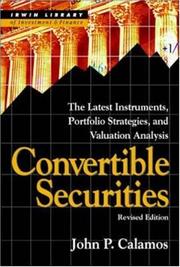
Convertible Securities

Convertible Securities

John P. Calamos
1998
T3 417 pages · about 6h 57m to read Open Librarygoodreads

Instruments, portfolio strategies and valuation from the best-known convertible manager.

Summary

John Calamos, who founded the investment firm specialising in these instruments, wrote a practitioner reference on convertible securities covering valuation, analysis and portfolio application.

The instruments covered include convertible bonds, convertible preferred stock, mandatory convertibles, and the structured variants including zero-coupon convertibles and exchangeable securities where the conversion is into a different company's shares.

The analytical framework treats a convertible as a combination of components. The investment value is what the security would be worth as straight debt or preferred given the issuer's credit and prevailing yields, which sets a floor. The conversion value is the market value of the shares receivable on conversion. The premium over conversion value and the premium over investment value together describe the security's position, and the ratio between the two determines whether it behaves more like a bond or more like a stock. Calamos develops measures for this including the break-even period, meaning how long the yield advantage takes to recover the conversion premium.

The portfolio argument is that convertibles as an asset class have delivered equity-like returns with lower volatility, because they participate in a substantial share of upside while the bond floor limits downside, and that this makes them useful for investors who want equity exposure with reduced drawdowns. He supports this with long-run return data on convertible indices.

He also covers the arbitrage application, the credit analysis required, and the specific risks including issuer calls that force conversion at unfavourable times.

The long-run return claim depends on the index construction and on the period measured, and convertible performance has varied considerably by cycle. The book is a practitioner reference from 1998 and market structure has developed since, particularly with the growth of hedge fund participation which changed how convertibles are priced at issue.

Key takeaways 7

  1. A convertible's investment value as straight debt sets a floor, and the conversion value tracks the equity, with the premiums between them describing its behaviour.
  2. A convertible trading near its investment value behaves like a bond while one trading near conversion value behaves like a stock.
  3. The break-even period measures how long the yield advantage takes to recover the conversion premium paid.
  4. Convertibles have historically delivered equity-like returns with lower volatility because they capture upside while the bond floor limits downside.
  5. Issuer call provisions can force conversion at times unfavourable to the holder, which caps the upside.
  6. Credit analysis matters because the bond floor that limits downside depends entirely on the issuer's ability to pay.
  7. Hedge fund participation changed how convertibles are priced at issue, which affects the historical return comparison.

Who should read it

Investors considering convertibles as an asset class who want the valuation framework and the case for their risk and return profile.

Similar books 6

Chosen by shared topics, the entries that hold them, and the people who recommended both.
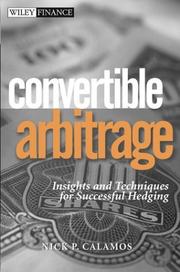
Nick P. Calamos · 2003

How convertible arbitrage hedges a convertible's stock, credit and volatility risk.
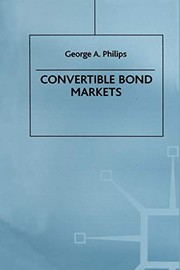
George A. Philips · 1997

Earlier market survey, useful on the pre-2000 issuance regime.
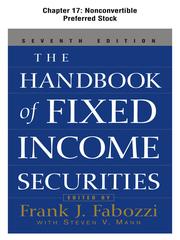
Frank J. Fabozzi · 2010

A handbook chapter on nonconvertible preferred stock as a fixed-income security.
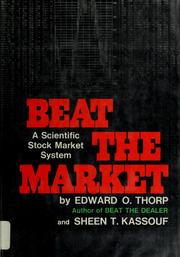
Edward O. Thorp, Sheen T. Kassouf · 1967

A method to price warrants and convertibles and hedge them against the stock.
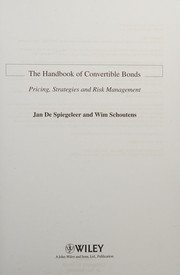
Jan De Spiegeleer, Wim Schoutens · 2011

How convertible bonds are priced, structured and risk-managed.
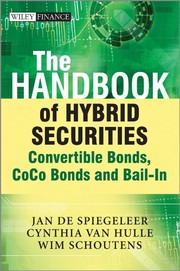
Jan De Spiegeleer, Wim Schoutens, Cynthia Van Hulle · 2014

Extends the same treatment to CoCos and other hybrids.

Where it sits in the reference 1

Assets

Topics

Finance and MarketsInvesting